



[Article updated on June 13, 2024]
The topic of payslip simplification has always been highly topical and experienced a resurgence in April 2024. The Senate’s review, starting June 5, of the proposed (major) simplification project for payslip display, detailed below, resulted in a clear refusal from the senators. Some saw a risk of increased procedural burden for companies, while others feared greater opacity in reading future payslips. Almost everyone who heard about the project was, in any case, resistant to it.
In any event, given the dissolution on June 9, the vote has not yet taken place on the entire bill. Nevertheless, what exactly did this simplification, announced in early 2024, consist of, and what were the planned differences compared to the already clarified current payslip? Our experts described it below.
Why are we talking about payslip simplification?
On April 23, 2024, the Minister of Economy and Finance, Bruno Le Maire, announced his intention to proceed with a radical simplification of employee payslips, stating, live on the 8 PM news, ” Today, you have a payslip with 55 lines (…). It is unreadable. We want a payslip that is about fifteen lines long, clear, simple, and legible for the employee.
This intention was confirmed on X (formerly Twitter) later that day by the same Bruno Le Maire. This proposal is part of the simplification bill presented to the Council of Ministers on April 24, 2024, by the Minister of Economy, initiating the preparation of a plan for simplifying standards applicable to businesses, which was defended by the Minister before the Senate’s Special Committee on May 14, 2024.
Who is concerned and what are the legal obligations of the payslip?
A recurring theme in administrative simplification measures, the payslip concerns all our salaried compatriots and highlights the extreme complexity of French payroll, and consequently, its expression, the payslip. Indeed, since 2023, an employee’s payslip must mandatorily include:
- Identification of the employer and employee (employer’s name and address, APE or NAF code, SIRET number, indication of the collective agreement applicable to the employee if applicable, employee’s name and job, as well as their position in the conventional classification, period and number of working hours or nature and volume of the flat rate for employees on a flat rate, nature and amount of salary accessories subject to employee and employer contributions).
- Salary-related information (employee’s gross remuneration, amount, rate, and basis of the various contributions and charges payable by the employer and employee before deduction of exemptions and exclusions, nature and amount of other payments and deductions – notably coverage of home-to-work transport costs -, amount actually received by the employee, payment date, absence dates and amount of absence compensation – leave, sickness, authorized paid absences – if applicable).
- Specific information on contributions (amount of social protection contributions grouped under 5 headings, total amount of exemptions and exclusions from social contributions, total amount paid by the employer and amount corresponding to the evolution of remuneration linked to the abolition of unemployment and sickness contributions)
- Net pay and taxable net income, as well as the amount of income tax withheld at source (taxable net amount used as the basis for calculating withholding tax, amount of tax withheld at source, annual cumulative amounts of income tax withheld at source, net amount of exempted complementary and/or overtime hours, as well as their cumulative total).
- The net income amount after deduction of all mandatory social contributions (net social income)
A payslip that was too complex?
All these lines are the culmination of a slow construction of the payslip, from its mandatory generalization in 1931 to the latest additions in July 2023 (particularly the net social income).
The impact study of the bill presented by the Minister of Economy lists no less than 5 laws or decrees, since 1998, that should have already simplified the payslip, but, “despite these successive initiatives, the payslip is still characterized by excessive complexity,” acknowledges the Executive. Bercy nevertheless believes that this complexity is not only explained by a bureaucratic frenzy often denounced, but that it is also “the direct consequence of the financing methods of social protection in France,” as well as the result of the multiple uses of the payslip, which also serves as “proof of employee income for third parties, a reference document in case of inspection, and often a preferred medium for the employer to transmit information to the employee.”
Thus, as recently as July 2023, a line creating the “net social amount” was added to allow employees to more easily find the resources to declare in order to obtain the activity bonus or RSA more systematically…
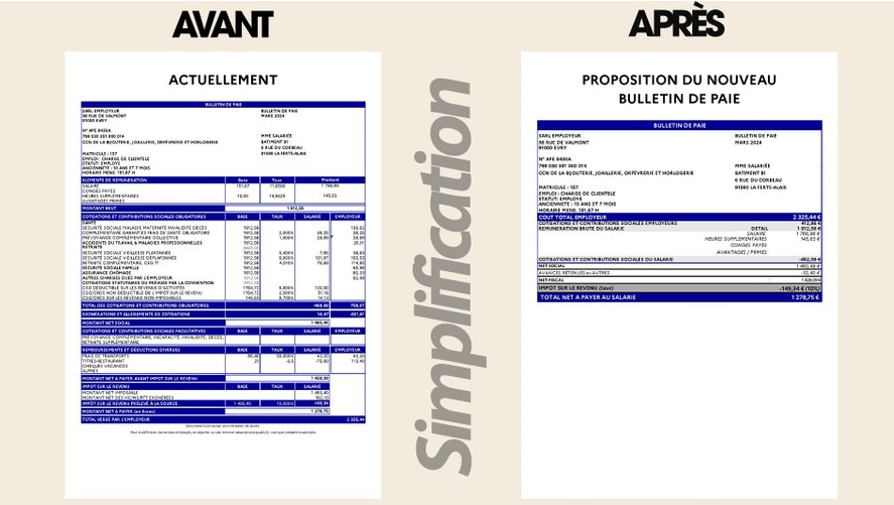
Faced with the excessive complexity highlighted by all stakeholders, employees and business leaders alike, not to mention internal or external payroll experts, the bill proposes to create a “highly simplified monthly payslip,” in which “only the main aggregates composing remuneration would now be reported, without the detail of social contributions made.”
In the example given in the impact study, the payslip would go from approximately 55 lines to about thirty, or even fifteen according to the Minister’s announcements: the new document would therefore see the disappearance of lines specifying the breakdown between all branches of Social Security (family, unemployment, retirement, AT), which represent the most difficult information for employees to understand.
A payroll simplification project, yes, but with some limitations…
- The first limitation highlighting the complexity of the subject: Bercy nevertheless warns that the employer must still be able to provide the employee, upon request, with the “information necessary to reconstruct the amounts appearing on their payslip.”
- The second limitation, this time reflecting the urgency of waiting and reflecting before launching this project: this new overhaul will not be immediate, the Executive giving software publishers until 2027 to adapt, as by that date a social data bank, the “National Social Rights Portal,” will be implemented. The detail of social contributions on the payslip will then be gone, under the pretext of making life easier for companies that would not have to fill out the complete payslip, which will be made available to employees on this new portal, whose data feeding, even if not specified, should be done via the DSN…
Barely unveiled, the payslip simplification project is already under fire from unions and opposition parties, both right and left, notably highlighting the fact that the disappearance of a certain amount of structuring information (detail of overtime, exceeding hours, recuperation, various counters, etc.) risks hindering employees in checking their rights, with the CFDT not failing to denounce that “making information disappear is not simplification, it is oversimplification. Under the pretext of simplification, we lose understanding.” At the same time, some denounce a “desire to make the role of social contributions invisible,” while a more “liberal” fringe of the opposition criticizes the failure to address the simplification not of the payslip itself, but of the methods for calculating its constituent elements, particularly in the area of contributions (calculation methods for the RGCS [general reduction of social contributions] in particular…).
A simplification that does not change the work of payroll managers
Indeed, it is highly likely that this simplification will prove to be merely cosmetic: while the form of the payslip will be simplified, the mechanisms of its preparation will remain unchanged, and thus the importance of the actions contributing to its production. The workload of payroll managers will remain the same, both in terms of collecting information (overtime/complementary hours, absences, bonuses, and various variable elements) and specific calculations (contribution rates and bases, specific reductions, complex indemnities – particularly in the context of final settlements -) will remain at the very least unchanged, or even increased, because the simplified presentation of the payslip will in no way reduce the checks carried out by the payroll department to ensure salary compliance, and risks, conversely, generating an influx of questions from employees, now deprived of certain information on their payslip and eager to ensure the correct payment of such and such a variable, or the correct exemption from charges for such and such a quota of hours…
It is to be feared that this simplification reform will be limited to the payslip itself, serving to conceal the forest of complexity in French payroll regulations, especially when we know that, each year, 185 new texts (legislative and/or regulatory) are published impacting the format, presentation, or calculations of the payslip…
How to improve payslip readability:
In our opinion, improving payslip readability will more certainly involve:
- educational work with employees on the main payroll rules (who, within a Shared Service Center [CSP], has not had to explain to an employee why their net pay appears lower than usual in the months following the payment of a large bonus that led to a tax bracket change that then needs to be gradually compensated for?);
- but above all, by a complete overhaul of the most complex payroll calculation rules, particularly in terms of contributions (brackets and ceilings, CSG/CRDS basis, RGCP) but also the integration of complementary amounts into the gross salary (social and fiscal reintegration in particular)…
Thanks to its twenty years of expertise in payroll calculation and the parameterization of Payroll IS, Althéa is the ideal partner to support payroll departments in analyzing the impact of this upcoming payslip simplification on the tools used to produce payroll, as well as in reflecting on the subsequent changes this simplification will bring (adaptation of controls, implementation of platforms for answering employee questions, chatbot development, etc.).
Contact us…!
Or consult our experts: