



The year 2025 is approaching, bringing with it major transformations for Human Resources professionals. At Althéa, we look at these developments with an informed perspective, recognising that HR is the true driver of organisational performance. So what are the 2025 HR trends that will shape business success? How can new HR practices turn challenges into strategic opportunities?
Pay transparency: a question that comes up and that people can relate to—should it be integrated?
I. Artificial intelligence: a catalyst for HR performance in 2025
Artificial intelligence (AI) is becoming an increasingly indispensable tool in HR processes. How can AI optimise your operations, strengthen your efficiency and boost HR performance in 2025?
- Smart, targeted recruitment: AI makes it possible to accurately identify the most suitable talent, refine sourcing and significantly reduce time-to-hire. By automating repetitive tasks, recruiters can refocus on assessing human skills and cultural fit—absolutely essential elements.
- Advanced training personalisation: thanks to AI, it becomes possible to design tailored learning pathways that meet the specific needs of each employee. This individualised approach fosters greater engagement, faster skills acquisition and optimised HR performance in 2025 over the long term.
- Predictive turnover analysis: AI excels at analysing HR data to anticipate departure risks and implement targeted retention strategies. By identifying risk factors, companies can act proactively to retain their key talent.
AI should be seen as a tool in service of people. The expertise of HR professionals is essential to interpret data, make informed decisions and ensure an authentic, personalised employee experience. In fact, without the human element, we risk falling into algorithmic biases that could be detrimental.
II. Flexibility and agility: the pillars of the future of HR and management
Flexibility has become a decisive criterion for attracting and retaining talent, particularly among younger generations. How can companies reconcile flexibility, agility and HR performance in 2025?
- Implementing a structured and transparent flexible framework: it is essential to establish clear, transparent policies to govern remote work, flexible hours and other forms of flexibility. A well-defined framework prevents potential abuse, ensures fairness between employees and maintains team cohesion—fundamental aspects.
- Strategic investment in digital collaboration tools: to ensure smooth communication and effective collaboration, investing in digital tools tailored to teams’ specific needs can be particularly beneficial. These tools should simplify information sharing, project management and maintaining social connection, even remotely.
- Rigorous measurement of the impact of flexibility: to assess the effectiveness of flexibility policies, we recommend tracking key indicators such as productivity, engagement, employee well-being and retention rate. This data makes it possible to adjust practices and optimise results, ensuring that flexibility benefits both employees and the company.
Companies that take a proactive approach to flexibility create a working environment where employees feel valued, supported and empowered, while actively contributing to the company’s HR performance in 2025.
III. Mental health and well-being: an ethical and performance challenge
Employees’ mental health is a growing challenge for companies. They must act to prevent psychosocial risks and promote a healthy, fulfilling work environment. How can this dimension be effectively integrated into new HR practices?
- Rolling out prevention and awareness programmes: raising employees’ awareness of psychosocial risks and providing them with the tools they need to manage them is a strategic focus that should not be overlooked. These programmes may include stress management workshops, training in non-violent communication and individual coaching sessions, providing comprehensive support.
- Training managers in active listening and empathy: managers play an essential role in preventing psychosocial risks. It therefore becomes crucial to train them in active listening, empathetic communication and detecting signs of distress.
- Creating a company culture based on care and support: a positive company culture, built on trust, respect and mutual support, is a key factor in well-being at work. Companies can encourage open communication, recognition of effort and celebrating successes.
Investing in employees’ mental health is not only an act of social responsibility, but also a strategy to improve HR performance in 2025, reduce absenteeism and strengthen the company’s attractiveness.
IV. Pay transparency: a pillar of trust and fairness
Pay transparency is a topical issue that raises a number of questions. How can companies address these different questions constructively, paying particular attention to the positioning of potential candidates and enhancing the attractiveness of their offers?
- Clear, transparent communication on pay criteria: it is important to explain to employees honestly the criteria taken into account to determine salaries and potential pay rises. This communication must be objective, factual and based on transparent data.
- Mise en place de politiques salariales équitables et non discriminatoires : les entreprises doivent veiller à ce que leurs politiques salariales soient équitables et non discriminatoires, notamment en ce qui concerne l’égalité salariale entre les femmes et les hommes.
- For companies with 250 to 999 employees
The employer chooses a reference period of 12 consecutive months to assess pay and promotion gaps between men and women. Certain employees (apprentices, expatriates, etc.) are excluded from the calculation. The index is calculated out of 100 points based on 5 key indicators.
Companies must declare their index each year on Égapro, include it in their BDESE, and publish it on their website before 1 March.
Score < 75: Implementation of corrective measures.
Score between 75 and 85: Setting improvement targets.
Score ≥ 85: No additional obligation. - For companies with more than 1,000 employees
The process is similar, but if a company scores less than 75 points for 3 years, it risks a penalty of up to 1% of payroll.
- For companies with 250 to 999 employees
- Open, constructive dialogue with employees: it is important to encourage dialogue on pay issues, listen to employees’ concerns and answer their questions transparently and honestly, for example during annual reviews.
Pay transparency can strengthen trust, engagement and employee motivation, while improving the company’s brand image and attracting top talent.
V. Company culture: a driver of sustainable performance and innovation
Company culture is a fundamental element of an organisation’s identity and performance. How can companies cultivate a positive, innovative culture focused on HR performance in 2025?
- Defining a clear, shared vision: all employees must understand the company’s mission, values and objectives, and feel aligned with that vision. These are, for example, strategic priorities to highlight in manifestos in order to formalise the company culture both internally and to help it shine externally.
- Promoting diversity, equity and inclusion: companies must create a working environment where everyone feels respected, valued and included, regardless of their origin, gender, age or sexual orientation. This is a major challenge for large groups. L’Oréal is a case in point, through the rollout of its mentorship programme for inclusion, diversity and equal opportunities in the workplace. These initiatives include mentoring for minorities, female leadership and reverse mentoring. The company fosters an inclusive environment with actions focused on equity, disability and LGBTQIA+ diversity.
- Encouraging innovation and continuous learning: companies must encourage employees to develop their skills, experiment with new ideas and step out of their comfort zone, for example by promoting innovation through the creation of innovation hubs or through continuous training. This is the case at Althéa, which launched “Althéa Academy”, a continuous training programme designed to give employees the opportunity to upskill and cross-share each person’s expertise.
A strong, positive company culture attracts top talent, fosters innovation and contributes to the company’s overall HR performance in 2025.
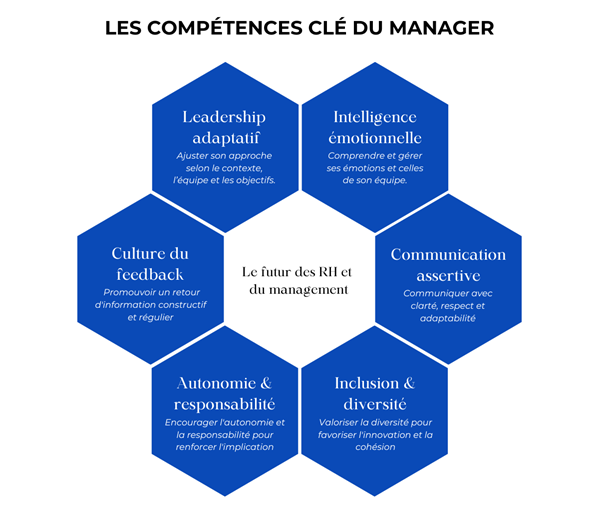
VI. The future of management: adaptive leadership and emotional intelligence in the service of performance
The manager’s role is evolving, shifting from an authoritarian model to adaptive, people-centred leadership. Here are the key skills:
VII. Measuring HR performance: an imperative for the future of HR and management
HR must demonstrate its added value by measuring the impact of its actions on the company’s overall HR performance in 2025. What key indicators should be tracked for the future of HR and management?
- Turnover: measure staff turnover rate and identify the causes of departures.
- Employee engagement: assess the level of involvement and motivation of teams.
- Productivity: track changes in output and quality of work.
- Return on investment (ROI) of HR actions: calculate the financial benefit of HR initiatives (training, recruitment, well-being, etc.).
The 2025 HR trends offer considerable opportunities for companies that can anticipate them and integrate them into their strategies. At Althéa, we are convinced that human resources are the key to sustainable performance. That is why we support you in implementing innovative, tailored solutions, to make your HR a true competitive advantage.
Would you like to learn more about our HR consulting services and how we can help you navigate the 2025 HR trends? Contact us today for a free consultation!