


The transformation of the HR function is expanding in scope. Process digitalization, the growing power of data, increasing integration of HRIS suites, and heightened demands for performance and steering: HR Departments are evolving in a structurally more complex environment.
To address this evolution, Althéa is consolidating its HR transformation expertise within a unified practice: HR Transformation, designed to offer a global, integrated, and empowering approach.
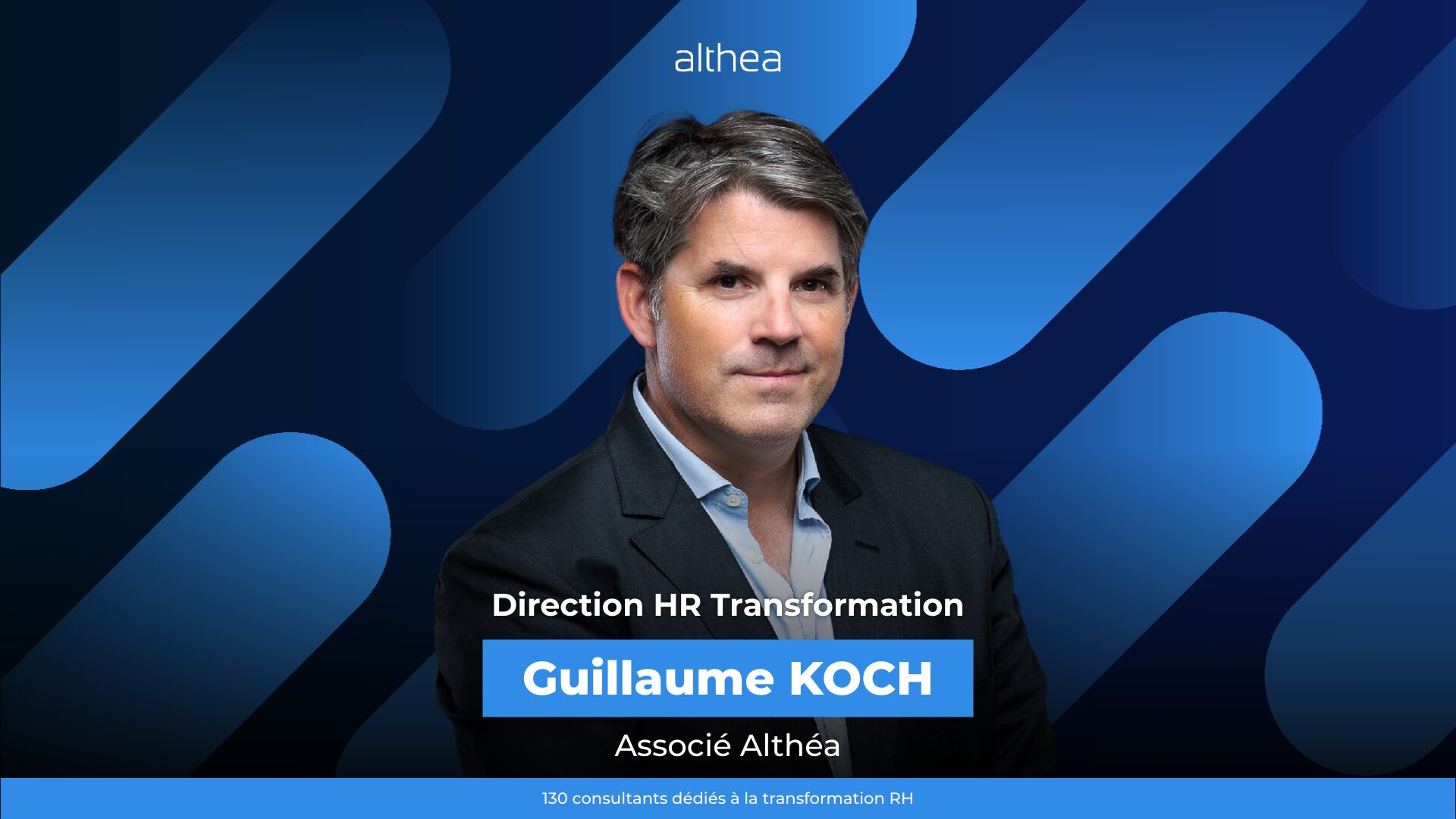
As part of its NextGen 2030 strategic trajectory, the firm has entrusted its leadership to Guillaume Koch. This new practice currently brings together nearly 130 consultants dedicated to supporting HR transformations.
This structuring marks a true change in dimension for Althéa, which is adopting a model capable of articulating business expertise, technological mastery, and data-driven steering, in order to support HR Departments in all their challenges.
Guillaume Koch, Partner in charge of HR Transformation, shares the vision guiding this evolution.
HR Transformation Has Become Systemic
How do you analyze market developments?
We are observing a change in nature. HR projects are no longer isolated from the rest of the company. They are now part of global trajectories that engage the organization, systems, skills, and governance in a fully transversal manner.
While vendor suites cover the entire HR value chain by silo, obtaining a business interpretation of this data remains difficult. Our main challenge is to support them in achieving this objective, to articulate operational performance, compliance, organizational transformation, and employee engagement.
Finally, the long-awaited true strategic architecture.
Adapting the Model to HR Directors’ Expectations
How does this challenge traditional organizational models?
When needs become transversal, siloed organizations reach their limits. Isolated expertise can be effective within a specific scope, but it is no longer sufficient when it comes to supporting global transformations.
HR Departments today expect partners capable of articulating strategic vision, operational mastery, data capitalization, and a deep understanding of technological challenges. This requires an organization capable of mobilizing multiple skills in a coordinated and coherent manner.
It is with this logic that we decided to structure HR Transformation around an integrated model.
A Structured and Empowering Organization
How is this evolution concretely reflected at Althéa?
We have structured our activity around clearly identified offerings covering all HR challenges: Payroll, Skill-Based Organization, Core HR / HR Data, Employee Excellence, Time, Planning, and Operations.
Each of these offerings is embodied by a leader responsible for its vision, development, and quality of execution. This empowerment is a key element of our model.
Payroll is thus led by Magali Covain, Skill-Based Organization by Margaux Bonnet, Core HR / HR Data by Clémence Levinson, Employee Excellence by Fatima-Azzahra Lemzaoui, the Time offering by Florian Dugrenil, Planning by Xavier Kelma, and Operations by Christophe Ferreira.
Support for the public sector relies on the expertise of Thomas Luks, Jean-Julien Lecomte, and Maud Vaccon, who adapt our model to the regulatory and organizational realities specific to public actors.
This structuring provides clarity to the market and strengthens internal accountability. It also allows for the articulation of skills, in order to address our clients’ business issues comprehensively.
We are building a coherent model, capable of adapting to the complexity of current transformations.
A Common Methodological Backbone
How does this model differ from a simple reorganization?
Methodological coherence is a central element.
Approaches to Target Operating Model, master plan, project steering, business analysis (AMOA), data management, or change management are not tied to a specific offering. They form a common foundation, a link between all missions that resembles the DNA of HR Transformation.
This convergence guarantees homogeneous quality of execution, fosters the capitalization of best practices among our consultants, and strengthens industrialization capacity. It also ensures continuity between the different building blocks of our clients’ transformation.
Methodology thus becomes a structuring factor in our performance for our clients.
Data at the Heart of HR Decision-Making
What role does data play in the HR Transformation model?
Data has become a strategic lever for HR Departments. They must now manage payroll, anticipate skill needs, measure social performance, and demonstrate their direct contribution to the business.
However, this data is often fragmented across several specialized systems: payroll, time management, talent, planning, or financial tools.
The value lies not only in the tool, but in the ability to extract this multi-system data, ensure its quality and consistency, and then project and present it in a business context.
Our expertise lies precisely in this ability to work with complex data to make it a true strategic decision-making tool.
Developing Responsibility and Employability
Does this evolution also have an internal dimension?
It is inseparable from our managerial ambition. We want to offer our managers and consultants a framework that promotes transversality, taking responsibility, and skill development.
While operational excellence driven by expertise remains essential, it must nonetheless be part of a broader vision that enables end-to-end transformation support, serving the business. This approach enhances the employability, attractiveness, and engagement of teams.
An Ambition Embedded in the 2030 Trajectory
How does this evolution fit into Althéa’s strategy?
Our NextGen 2030 strategic plan is based on profitable and structured growth. To achieve this ambition, HR Transformation must establish itself as a global partner for HRDs, capable of intervening at all key stages of a business transformation.
This change is already perceptible in the missions we are currently carrying out; we have chosen to anticipate an increasingly strong signal from our clients.
HR transformation is no longer a one-off project. It constitutes a strategic architecture that requires an adapted, coherent, and responsible model.