



GEN AI is no longer a topic reserved for digital departments or innovation teams. It is now entering the daily lives of support functions, operational business lines, and transformation departments. For Procurement Departments, this evolution marks a turning point.
Procurement is at the heart of a paradox. Rarely has its role been so strategic: securing supplies, controlling costs, supporting the CSR transition, reducing supplier risks, supporting innovation, contributing to operational performance, and preserving margins. But rarely have procurement teams been faced with such an intensity of requests, data to process, contracts to analyze, risks to monitor, and decisions to document.
In this context, GEN AI should not be seen as a simple productivity tool. It can profoundly transform how Procurement Departments analyze markets, identify suppliers, prepare negotiations, manage risks, leverage contracts, and support internal stakeholders.
The question is no longer whether Procurement should be interested in GEN AI. It is now a matter of knowing how to integrate it without losing what makes the function valuable: judgment, market understanding, risk management, negotiation skills, and proximity to business lines.
A transformation that begins with the actual work of buyers
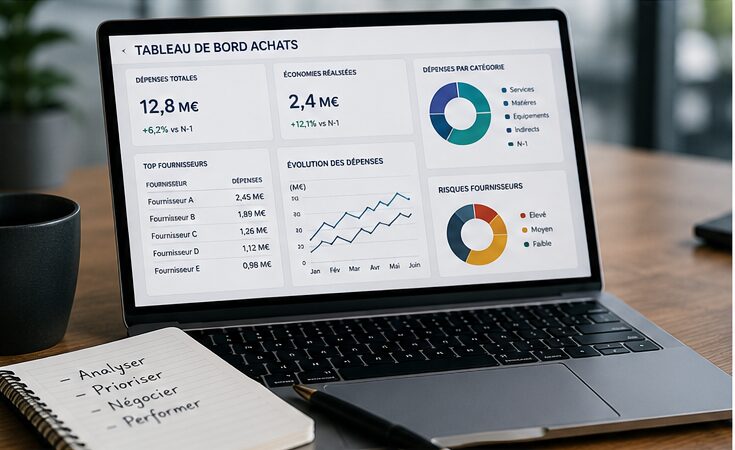
In many companies, the first discussions around GEN AI begin with tools. Which assistant should be used? Which solution should be integrated into existing procurement suites? How can supplier data be secured? Should internal use cases be developed or should market solutions be relied upon?
These questions are important. But they must not overshadow the starting point: the actual work of procurement teams.
What do category managers, project buyers, contract managers, supplier relationship managers, procurement operations teams, or supplier performance managers actually do? Where do they spend their time? Which tasks truly create value? Which ones consume energy without strengthening the quality of decisions? Which pain points slow down the procurement process? Which supplier data remains untapped?
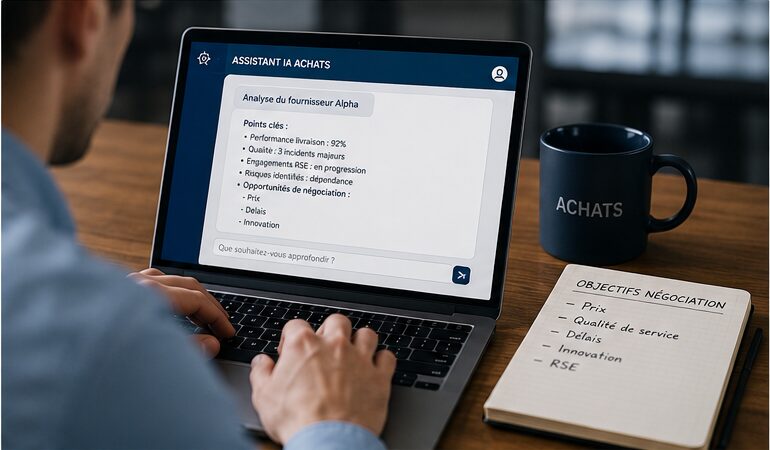
For a major retail player, one of the first observations was very concrete. Buyers spent a significant portion of their time preparing supplier reviews from scattered sources: order history, quality incidents, delivery delays, disputes, contracts, pricing conditions, CSR data, and internal exchanges with business lines.
All this information existed. But it was rarely consolidated in a fluid manner. Each supplier review required significant manual work to gather elements, identify points of tension, prepare messages, and distinguish real issues from weak signals.
GEN AI was envisioned as a support for preparing these reviews. Not to replace the buyer’s analysis, but to produce an initial structured summary: which incidents are recurring? Which contractual commitments are weakened? Which points should be addressed as a priority? Which risks deserve particular vigilance? Which topics can open a progress discussion with the supplier?
The gain did not lie only in the time saved. It lay in the change of posture. Buyers spent less time assembling information and more time preparing their discussion strategy, challenging suppliers, engaging business lines, and building improvement plans.
Automate, Augment, Transform: Three Very Different Realities
One frequent mistake is to speak of GEN AI as a homogeneous block. For a Procurement Department, its impacts vary greatly depending on the activities.
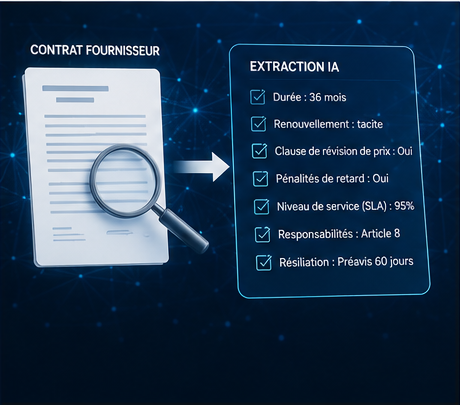
Certain tasks can be largely automated: contract summaries, clause extraction, procurement request classification, meeting minutes preparation, supplier response analysis, drafting initial consultation documents, market data consolidation, or document searches in internal repositories.
Other activities are augmented. The decision remains human, but it is better prepared, faster, and more documented. This is the case for strategic sourcing, negotiation preparation, make-or-buy analysis, supplier risk assessment, procurement scenario building, or supplier performance management.
Finally, some missions are profoundly transformed. The buyer is no longer limited to launching consultations and negotiating prices. They become more of a market analyst, a risk manager, a business partner, and an architect of supplier performance. The contract manager focuses less on manual searches for contractual information and more on securing commitments. The procurement analyst evolves into a procurement data partner. The SRM manager becomes an orchestrator of the value created with strategic suppliers.
For an international industrial group, the reflection was conducted based on a mapping of procurement activities. The teams wanted to identify the processes where GEN AI could truly bring value without weakening risk management.
Tender management quickly emerged as a priority area. Buyers spent a lot of time analyzing long, heterogeneous supplier responses that were sometimes difficult to compare. GEN AI could help structure an initial reading: summarizing proposals, identifying gaps with specifications, spotting differentiating commitments, extracting reservations, and preparing a comparison grid.
The decision obviously remained in the hands of buyers and business lines. But the initial analysis was accelerated, better structured, and allowed teams to focus on high-stake points: risks, differentiation, operational robustness, quality of the supplier relationship, and negotiation levers.
Procurement performance is no longer limited to cost reduction
GEN AI is often approached from the perspective of productivity. This is understandable. Procurement Departments must process more requests, manage more categories, and integrate more criteria, all while controlling their headcount.
But limiting GEN AI to an efficiency tool would be reductive.
One of the major challenges is the ability of Procurement to better contribute to the overall performance of the company. In many sectors, levers remain under-exploited due to a lack of time or analytical capacity: pooling of needs, supplier rationalization, anticipation of market tensions, targeted renegotiation, supplier innovation, risk reduction, cash improvement, and CSR contribution.
For a fast-growing B2B services company, the initial focus was on controlling indirect procurement. Expenses were numerous, scattered, and often incurred by business lines with varying levels of formalism. Data existed in the ERP, expense report tools, contracts, purchase orders, and invoices. But the analysis remained fragmented.
GEN AI made it possible to envision a system to assist in spend analysis. The goal was not simply to produce additional reporting, but to identify optimization pockets: redundant suppliers, unused contracts, maverick spend, recurring expenses without framework agreements, and categories with significant price discrepancies between entities.
In this case, GEN AI did not just serve to go faster. It opened the possibility for finer, more targeted, and more proactive procurement action. Teams could better identify value pools, prioritize projects, and engage business lines with concrete facts.
This is an important evolution. GEN AI should not be thought of solely as a way to reduce administrative burden. It can help Procurement seek value where the company did not always have the means to analyze quickly or finely enough.
The Procurement Director: Guarantor of Supplier Trust and Ethics
This transformation raises a central question: who guarantees the quality of what is produced?
In Procurement, a poor analysis can have serious consequences. An underestimated supplier risk, a misinterpreted contractual clause, unverified CSR data, a poorly compared supplier response, or an insufficiently challenged sourcing recommendation can weaken the company.
Because GEN AI produces fluid and convincing answers, it can give an impression of mastery. But this impression is not enough. Procurement handles sensitive data: prices, contracts, negotiation strategies, supplier information, specifications, commercial conditions, and sometimes confidential data related to business lines.
The role of the Procurement Director therefore becomes decisive.
It is not about slowing down usage, but about framing it. Defining authorized use cases. Clarifying usable data. Specifying necessary validation levels. Protecting sensitive information. Ensuring that CSR, compliance, economic dependence, sovereignty, or business continuity criteria are correctly integrated. Training teams to challenge generated responses.
For a major telecommunications player, this question of trust was placed at the center of the approach. Procurement teams immediately saw the interest of GEN AI for preparing consultations, analyzing contracts, summarizing offers, or accelerating market monitoring. But the risk was clear: allowing individual, unsecured uses on sensitive data to develop.
The first step therefore consisted of prioritizing use cases according to their criticality. Assisting in the summary of public supplier documentation does not involve the same requirements as an assistant used to prepare a strategic negotiation. Extracting contractual clauses does not present the same risks as a recommendation on the choice of a critical supplier.
This approach avoids two pitfalls: uncontrolled enthusiasm and blocking by principle. Simple uses can be experimented with quickly. Sensitive uses must be framed with greater rigor. The Procurement Department can move forward, but without compromising its standards of confidentiality, ethics, and risk management.
Procurement skills will evolve faster than organizations
The most underestimated topic probably remains that of skills.
GEN AI does not just transform tasks. It modifies the qualities expected of procurement teams. Knowing how to formulate a good question becomes a professional skill. Knowing how to challenge a generated response becomes indispensable. Knowing how to cross-reference a summary produced by AI with market knowledge, a negotiation strategy, or supplier reality becomes a key competency.
In Procurement Departments, this evolution will create new gaps. Some buyers will quickly adopt these tools and significantly increase their impact. Others will remain behind, not due to a lack of professional competence, but for lack of support, framework, or time to experiment.
For a transport group, the analysis of procurement roles revealed a sensitive point. The most experienced buyers perfectly mastered suppliers, negotiation histories, operational risks, and internal balances. Younger profiles were often more comfortable with new tools but less equipped to interpret the subtleties of a supplier relationship or a tight market.
Value could only be born from the meeting of the two.
The approach was therefore designed as a transformation of practices. Pairs were formed between procurement experts and more digital profiles. The former brought judgment, supplier knowledge, and negotiation finesse. The latter tested uses, formulated queries, structured analyses, and identified possible gains.
The use cases were then discussed collectively: what truly creates value? What is reliable? What must remain in the hands of the buyer? What can be prepared by the tool but validated by a human?
This dimension is essential. A Procurement Department will not succeed in its GEN AI transformation solely with technological solutions. It will succeed if it manages to evolve its practices, its skills, and its way of working with business lines.
Reclaiming time and strengthening Procurement’s impact
It would be naive to pretend that GEN AI does not cause concern. Certain tasks will decrease. Certain roles will evolve. Activities will be redesigned.
But an exclusively alarmist discourse is often counterproductive. It reduces transformation to a threat, even as many procurement teams today suffer from chronic overload: too many consultations to manage, too many contracts to follow, too many business requests to absorb, too much supplier data to analyze, and too many risks to monitor.
In several organizations, the most mobilizing message is not: “AI will replace part of the work.” It is rather: “AI can help us reclaim our time.”
Reclaiming time from overly long supplier analyses. From consultations prepared in haste. From tedious contract reviews. From insufficiently qualified business requests. From procurement reports produced too late. From market monitoring that one never has time to structure.
For a healthcare company, procurement teams were faced with heavy pressure on supplier security, compliance, CSR requirements, and cost control. The work carried out identified very concrete use cases: summarizing supplier files, analyzing sensitive contractual clauses, preparing performance reviews, assisting in the qualification of business requests, and monitoring supply tensions.
Taken separately, these cases might seem modest. Together, they outlined a trajectory: reducing the operational load to give buyers back time for what truly matters — category strategy, negotiation, supplier relationships, risk management, and value creation with business lines.
Experiment fast, but project far
Faced with the scale of the subject, some companies may be tempted to launch a major GEN AI Procurement program. This approach can sometimes be justified, but it carries a risk: delaying learning, distancing buyers from the subject, and turning GEN AI into a technological project before making it a business lever.
The most effective approaches often rely on a very concrete first axis: a few well-chosen use cases. Simple enough to be tested quickly. Useful enough to produce value. Visible enough to engage procurement teams and internal stakeholders.
For a Procurement Department, the fields for experimentation are numerous: spend analysis, supplier sourcing, tender preparation, response comparison, contract review, market monitoring, supplier risk assessment, business request qualification, negotiation preparation, and supplier performance management.
These use cases make it possible to move beyond general discourse on AI, to show concretely what the technology can bring, to reassure teams, and to reveal the real conditions for success: data quality, confidentiality, integration into processes, level of human control, and acceptance by business lines.
But this first axis is not enough.
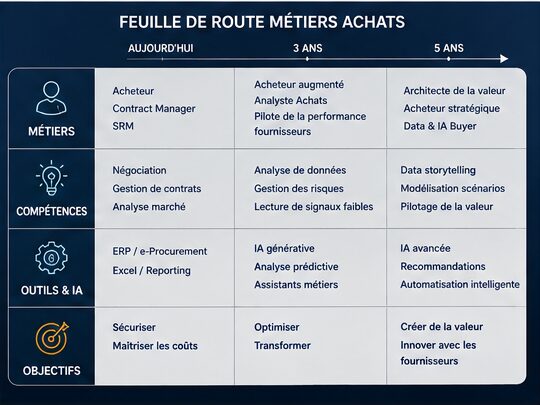
For a Procurement Director, the challenge is also to project 3-5 years ahead. Because GEN AI will not just transform a few isolated tasks. It will gradually modify the very structure of procurement jobs, expected skills, professional paths, and organizational balances.
It therefore becomes indispensable to evaluate, for each job and each major family of skills, the level of impact of GEN AI: what will be automated, what will be augmented, what will remain strongly human, what will require new skills, and what will cause new roles to emerge.
This projection is decisive. It allows for the anticipation of job description evolutions, the identification of critical skills to develop, the spotting of employees capable and willing to evolve toward these new roles, but also the clarification of recruitment needs.
A simple example illustrates this well: recruiting a category manager today without questioning what their job will become in three years constitutes a risk. Not because the job will disappear, but because it will be profoundly modified.
The buyer of tomorrow will likely need to master data analysis, the reading of weak market signals, the interpretation of summaries generated by augmented tools, the structuring of negotiation scenarios, supplier risk management, and the ability to interact with intelligent systems.
The question is therefore no longer just: does this candidate know how to negotiate, manage a panel, and lead a consultation today?
It also becomes: do they have the capacity, appetite, and curiosity necessary to become an augmented buyer tomorrow?
This reflection applies to all procurement roles: category managers, project buyers, sourcing managers, contract managers, supplier relationship managers, procurement analysts, sustainable procurement managers, supplier risk experts, and procurement operations teams. Not all will be impacted in the same way, but all must be viewed through this new analytical lens.
This is where part of the Procurement Director’s responsibility lies. It is not just about choosing tools or launching experiments. It is about preparing the Procurement organization of tomorrow: its roles, its skills, its evolution trajectories, its recruitment needs, and its new balances between human expertise and technological power.
The right question is therefore not just: “Which GEN AI use cases can we test quickly?”
It is also: “What Procurement Department do we want to build by the 3-5 year horizon, and how are we preparing the women, men, and skills today that will make it function?”
Getting into motion
GEN AI will not make the buyer’s role disappear. On the contrary, it reinforces its importance.
In an environment where market, supplier, and contractual information becomes more abundant, faster, and more complex to interpret, procurement discernment becomes even more precious.
The buyer of tomorrow will not just be the one who negotiates a price or secures a contract. They will be the one who helps the company transform the power of GEN AI into more enlightened supplier decisions, sustainable performance, risk management, and new spaces for value creation.
But this transformation cannot be approached solely through tools. It requires taking a step back to look at the procurement organization, roles, skills, processes, modes of collaboration with internal stakeholders, and the governance of usage.
It is precisely on these topics that Althéa supports companies.
As a transformation consulting firm, Althéa helps Procurement Departments and general management structure their strategic reflections, identify the concrete impacts of GEN AI on their organizations, and define trajectories adapted to their context.
Each company starts from a different situation: digital maturity, procurement organization, data quality, level of centralization, supplier challenges, cost pressure, CSR ambitions, and risk exposure. The challenge is therefore not to apply a standard response, but to build a pragmatic initial reading of opportunities, risks, and priorities.
For Procurement Departments wishing to initiate this reflection, an initial approach can help answer a few simple questions: where can GEN AI quickly create value? Which roles will be the most transformed? Which skills will need to evolve? Which use cases should be tested as a priority? And what procurement organization should be built for the 3-5 year horizon?
Our teams would be delighted to discuss with you to initiate this reflection in your context and identify the first value levers for your Procurement Department.
Written by