



Jamel-Cédric LEMA (Engagement Manager), Ophélie AGARD (Senior Manager), and Sébastien TROHEL (Senior Manager), Althéa.
In a world marked by political and economic uncertainty, evolving standards and regulations, the climate emergency, technological disruptions, and changing employee expectations, finance departments are more than ever facing strategic alignment and operational agility challenges. They no longer merely oversee financial results: they drive the resilience and transformation of organizations.
It is in this context that EPM (Enterprise Performance Management) emerges as a strategic lever for integrating these underlying trends and increasingly complex criteria to master.
But what is EPM? What transformations do these tools enable, and how can companies prepare to address the challenges of 2025 and beyond? The Althéa Consulting Firm offers a comprehensive overview.
What is EPM and why is it strategic for 2025+?
Enterprise Performance Management (EPM), or Corporate Performance Management (CPM), are two acronyms that literally mean: Enterprise Performance Steering¹. It is, above all, a set of processes, methodologies, and technological solutions designed to provide a proactive and strategic management foundation for businesses. EPM solutions enable the consolidation, harmonization, and analysis of financial and operational data, as well as the modeling and simulation of complex scenarios. They offer companies strong anticipation capabilities for informed decision-making.
But let’s revisit the history of EPM solutions to better position them in relation to the evolving needs of finance departments.
History and Evolution of EPM Solutions
The evolution of EPM solutions is closely linked to the growing needs of businesses and technological advancements. Since the 1980s, three major phases have marked this progression, each reflecting a direct response to the economic and organizational demands of its era:
The 1980s-2000s:
During this period, companies primarily faced complex organizational structures (multi-entity, multi-site) and needed to centralize their financial data and produce reliable consolidated statements compliant with local (US GAAP, French GAAP) and international (IFRS) standards. This required rigorous closing and reporting processes.
Technologically, these tools were exclusively installed on-site, « on-premise », and relied on relational databases to centralize and harmonize data. This marked the emergence of the first CPM solutions, such as Micro Control in 1981 by IMRS, which later became Hyperion and Hyperion-Essbase (introducing multidimensional analysis capabilities via OLAP (Online Analytical Processing)), before being acquired by Oracle in 2007.
Expansion of Functional Scope (2000-2010)
The turn of the new millennium saw companies operate in a context of increasing globalization and economic uncertainty. This highlighted the need to anticipate and plan for the future, by integrating non-financial dimensions into management processes. This era marked the transition from CPM tools, focused on finance, to EPM solutions, integrating strategic planning, more dynamic budgeting, and continuous rolling forecasts.
These tools, often referred to as “second generation”, were designed for easier adoption. They were distinguished by a “user-friendly” interface and strong integration with Microsoft Excel. They offered the advantage of a low learning curve and laid the groundwork for real-time collaboration. Examples include OutlookSoft (founded in 2000), which offered Business Process Management solutions (like Business Objects, acquired by SAP in 2007), and Cognos (acquired by IBM in 2008). This decade marked the golden age of EPM solutions, where cross-functional collaboration between departments (finance, HR, production) became essential to align strategic objectives with daily operations.
The Era of Cloud and Artificial Intelligence (Since 2010)
The 2010s were marked by profound new economic and technological changes. Market volatility, the acceleration of economic cycles, and the emergence of environmental, social, and governance (ESG) issues pushed companies to seek more flexible and agile tools. The advent of cloud solutions met these needs by offering global accessibility, better scalability, and reduced infrastructure costs.
So-called “third-generation” EPM solutions integrate advanced predictive analytics functionalities (e.g., Monte Carlo modeling) and ESG Reporting. Thanks to artificial intelligence, they enable companies to shift from reactive to proactive management, better anticipating risks and maximizing opportunities.
Another key aspect of this era is the emphasis on real-time collaboration between financial and operational teams, greatly facilitated by unified and interactive platforms. Today’s tools combine the power of cloud technologies and data science, transforming raw data into strategic insights that enable rapid adaptation to market changes.
Two Main Axes: Consolidation and Planning
EPM solutions are generally classified into two main categories, each addressing specific challenges:
Financial Close and Consolidation Solutions (FCCS)
These solutions simplify the financial close process while ensuring compliance and operational efficiency: reducing consolidated account production times, centralizing and processing intercompany transactions, multi-entity, multi-currency consolidation, etc.²
Examples of solutions: Oracle FCCS, Blackline, Fluence Consolidation and Reporting, LucaNet, Solver Cloud Suite, Amelkis, …
Client case study: A major energy player in France deployed Oracle FCCS to reduce its closing times by 25% and automate 80% of its manual adjustments, all while ensuring IFRS compliance³.
Financial Planning Solutions (FPS)
These solutions offer the ability to test hypotheses (“What-If” modeling) and simulate complex scenarios to evaluate the impact of decisions (for example, during an acquisition or restructuring). They also integrate ESG indicators to align financial performance with sustainable performance⁴.
Examples of solutions: SAP Analytics Cloud, Workday, Anaplan, Pigment, …
Client case study: A global leader in the agri-food industry uses Anaplan to integrate ESG projections into its budget forecasts, allowing it to align its financial priorities with its sustainable development goals.
A Convergence Towards Unified Platforms:
Vendors are increasingly moving towards unified platforms. This trend of converging tools to reduce integration risks⁵ is not entirely new. Combining the functionalities of FCCS and FPS into unified platforms allows companies to centralize their Consolidation and Planning processes on a single interface. Examples include CCH Tagetik, OneStream, and Board.
What is the place of EPM in the technological ecosystem of companies?
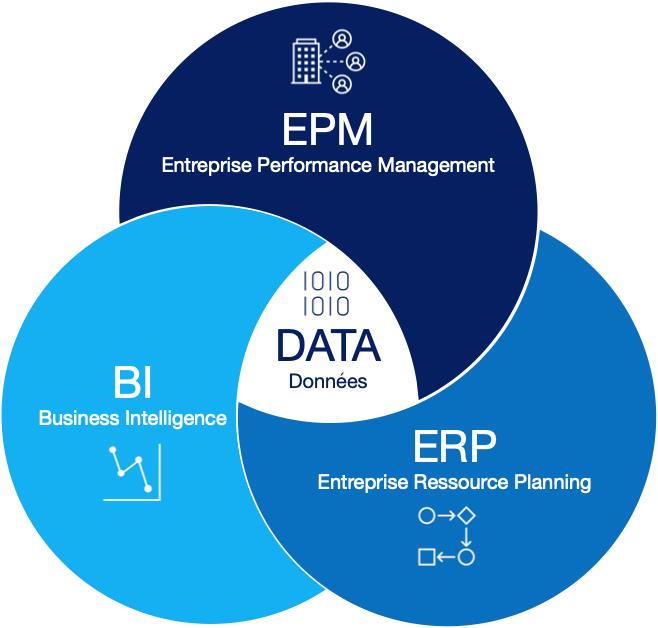
In the technological ecosystem of companies, EPM tools occupy a distinct but complementary position to ERP (Enterprise Resource Planning) and BI (Business Intelligence).
Indeed, unlike a Business Intelligence (BI) solution whose objective is to understand the past and identify trends through the exploration and analysis of historical data, or ERPs whose objective is to standardize and automate processes based on transactional data, EPM tools focus on strategic steering by planning and simulating hypotheses to guide future decisions.
| Characteristics | BI | ERP | EPM |
| Focus | Analysis of past data | Process Standardization and Automation | Strategic Steering |
| Key Questions | What happened? | How do we execute our operations? | How do we improve our performance? |
| Orientation | Analysis-based decision | Operational execution | Compliance, Planning |
| Examples of data used | Sales history, trends | Real-time transactional data | Consolidated data, Budgets, forecasts |
For finance departments, the real challenge today and tomorrow (2025+) lies in data and how it ensures synergy between the BI, ERP, and EPM triptych.
Example: A global cosmetics leader uses SAP Analytics Cloud (EPM) to align its financial forecasts with operational data collected by its ERP. This integration reduces budget variances by 15% through a centralized view of consolidated sales and margins⁶.
How Can Finance Departments Prepare for 2025+?
The key challenges for finance departments in the coming years primarily revolve around 3 main axes: integrating the ESG dimension into strategy, facing uncertainty through agility, and leveraging artificial intelligence.
Indeed, according to a 2024 McKinsey study⁷, 55% of CFOs anticipate their organization will focus on building sustainable businesses, considered an offensive move to strengthen corporate resilience. Similarly, the current context favors the adoption of EPM solutions that enable risk identification and real-time priority adjustment. Finally, the advent of AI enhances the proactive management capabilities of Finance Departments, using predictive algorithms that provide insights for decision-making.
Key Trends for EPM in 2025+
With the CSRD (Corporate Sustainability Reporting Directive), 75% of large companies will integrate ESG indicators into their financial reports starting in 2025 (Gartner). Solutions like CCH Tagetik and OneStream integrate predefined models aligned with TCFD (Task Force on Climate-Related Financial Disclosures) and GRI (Global Reporting Initiative) frameworks to measure carbon footprint or track Sustainable Development Goals (SDGs).
Example: A global agri-food leader used CCH Tagetik to reduce the consolidation time of its ESG data by 20%, ensuring reports compliant with new European requirements⁸.
By 2025+, 70% of companies will adopt cloud-based EPM solutions to gain agility and reduce infrastructure costs (between 20% and 40% depending on configurations). This transformation will lead to the decommissioning of second-generation EPM tools (for example, SAP BPC by 2027 and SAP BFC or Oracle HFM by 2030), impacting companies’ operational models and requiring preparation from Finance Departments and IT departments, as well as their functional and IT managers.
Furthermore, it should not be forgotten that the democratization of AI makes predictive functionalities more accessible to everyone.
Example: A French leader in mass retail uses OneStream to reduce stockouts by 12% via predictive algorithms⁹.
Strengthening Team Skills and Fostering Cross-Functional Collaboration
EPM solutions rely on cutting-edge technologies, increasingly integrating artificial intelligence (AI) and machine learning. These advancements require upskilling financial teams to ensure optimal adoption and mastery of these solutions.
However, a key challenge lies in integration. It is imperative not to deploy EPM tools in silos, as they are specifically designed to foster cross-functional collaboration and strengthen strategic alignment at all levels of the company.
To meet this requirement, some organizations have established Centers of Excellence (CoE) dedicated to EPM, which serve as hubs for expertise and governance. Others integrate EPM solutions with operational data, such as those from the supply chain, in a holistic approach called xP&A (Extended Planning & Analysis), aiming to further break down barriers between finance and operational functions.
In summary, finance departments are facing an even more turbulent period than previous decades and must prepare for it. Between evolving needs and technologies, they are seeking a solution to address tomorrow’s transformation challenges: external challenges (political, economic, regulatory) and internal ones (need for agility and employee skills) that must be absolutely considered, EPM tools that offer a complementary approach to existing systems (ERP and BI) with data at the heart of this synergy, more strategic than ever. Getting support to choose the right EPM solution becomes critical for companies.
The Althéa Consulting Firm Supports You in Choosing Your EPM Solution
Implementing an EPM solution is a strategic initiative that involves not only financial and human resources, but also major organizational and technological stakes. The framing and selection assistance phases, often underestimated, are nevertheless crucial to ensuring the success of these projects. Engaging Althéa, a consulting firm specializing in framing and selection assistance, offers distinct advantages and significant added value.
Methodological and Multi-sectoral Expertise
With over 40 selection assistance projects completed annually, the Althéa firm provides a clear and proven methodology for the framing and selection phases, adapted to the complexity and specificities of your organization. Our consultants possess business knowledge (former administrative and financial managers, consolidators, and management controllers) and sectoral expertise (banking, industries, retail, etc.) averaging 5 years, which allows us to identify problems specific to particular sectors.
An Objective and Independent Market View
The Althéa firm has no commercial interest or partnership with software vendors. This guarantees impartial support during the analysis of solutions. However, our 250+ consultants, from top consulting firms and integrators, conduct continuous technological monitoring of available market solutions (leaders, innovations, etc.) to ensure an objective evaluation of tools based on criteria relevant to you (functional performance, costs, integration with the existing ecosystem, etc.). Our ambition is to support you in choosing and implementing the EPM solution best suited to your needs while limiting the risks of cost overruns or incompatibilities during the implementation phases.
Mastery of Governance and Organizational Challenges
Framing allows us to identify key roles (Finance, IT, business departments) and clarify responsibilities within the project. Our steering mechanisms are clear and structured (governance bodies, monitoring indicators) and enable us to maintain constant alignment among stakeholders.
A ROI-Oriented Approach
Our consultants perform simulations to measure potential gains (process optimization, reduced lead times, etc.) to give you a clear vision of the short, medium, and long-term benefits for your company. Through transparent and continuous communication with sponsors and operational teams, we ensure that your choices are aligned with your strategic priorities.
Do not hesitate to contact us to discuss your project: contact@althea-groupe.com
A big thank you to Jamel-Cédric Lema and Ophélie Agard for writing their expert article, a true contribution to enriching Althéa’s knowledge. Your expertise and commitment are invaluable, both for our teams and our clients.
¹Even if we must return to the history to understand the semantic nuance behind the terms CPM and EPM
²Reduction of up to 30% in average closing times, Gartner Magic Quadrant for Financial Close Solutions, 2024
³Oracle Success Story, 2024
⁴Anaplan ESG Use Case, 2023
⁵Difficult reconciliation between statutory accounts and management accounts
⁶SAP Success Story, 2023
⁷CFOs fostering fortitude, McKinsey, 2024
⁸CCH Tagetik Case Study, 2024
⁹OneStream Success Stories, 2023