



Migrating to S/4HANA imposes a seemingly contradictory dual requirement: deploying a harmonized group-wide Core Model while taking into account local specificities that contribute to the richness and complexity of each site. This tension between standardization and adaptation is, above all, a change management challenge. Successful projects are not those that uniformly impose a global model, but those that know how to orchestrate an intelligent adaptation, where change is perceived as relevant and applicable by each population.
The Pitfall of Undifferentiated Standardization
The most common mistake is to treat local adaptation as a simple linguistic translation or a superficial customization of the global change strategy.
Let’s take a concrete example in the services sector: a company deploys the same training path and change messages for its finance teams at headquarters and its management controllers in regional subsidiaries. The S/4HANA Core Model introduces automated financial closing, real-time Fiori reporting, and the end of Excel reprocessing. For headquarters teams, accustomed to digital tools and cross-functional collaboration, adoption is smooth. For controllers in subsidiaries, who work with local files, informal processes, and strong operational autonomy, the transition to S/4HANA represents a triple shock: loss of familiar tools, perception of increased centralization, and the need to interact with group processes they did not co-construct.
The result? Two-speed adoption, system circumvention from the first weeks, and widespread frustration among local teams who feel “forgotten” by the project. This scenario illustrates a recurring reality: a well-designed Core Model becomes counterproductive if the accompanying change is not adapted to locally experienced realities.
Establishing the Methodological Framework: Distinguishing the Invariant from the Adaptable
Before any local adaptation, the first methodological step is to establish a clear dividing line between what cannot vary and what must be adjusted.
What is invariant: the “what.” Standardized S/4HANA processes, Core Model management rules, group compliance requirements, expected performance objectives. These elements precisely constitute the value of harmonization.
What is adaptable: the “how.” Support modalities, training formats, change messages, skill development timelines, animation rituals, educational materials. It is within this scope that local adaptation expertise is exercised.
This distinction must be formalized and shared with project teams from the outset, to avoid two opposing pitfalls: subsidiaries attempting to renegotiate the Core Model in the name of local specificities, and central teams imposing it without allowing room for adaptation.
Mapping Local Realities: A Structured Immersion
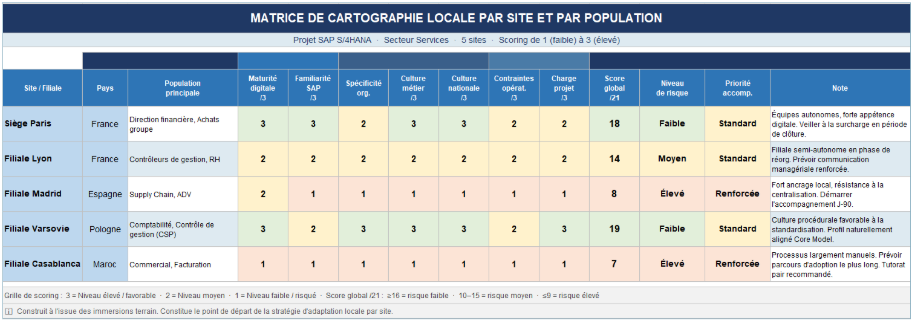
Mapping local realities is the backbone of any relevant adaptation. It is not done from headquarters based on HR data or an online questionnaire. It relies on structured field immersion, conducted along four lines of investigation.
- Actual digital maturity: This involves understanding how teams actually work. Do they use collaborative tools? Are they comfortable navigating complex interfaces? Have they already experienced a digital transformation? A site with a high SAP ECC level but very manual practices around the system does not have the same support profile as a site with little SAP usage but highly digitized daily practices.
- Organizational specificities: Roles and responsibilities vary by country and structure. A management controller in an autonomous subsidiary does not have the same interactions as a controller in a centralized matrix organization.
- Business and national cultures: Some populations are accustomed to autonomy and local decision-making, while others expect clear directives and a prescriptive framework. Change must be formulated and facilitated differently according to these realities.
- Operational contexts: Production, pace, and workload constraints directly influence teams’ capacity to absorb change.
Structuring Two-Tier Change Governance
The articulation between global harmonization and local adaptation relies on two-tier change governance, with clearly defined roles, responsibilities, and tools for each:
- At the global level, the change management team defines the strategic framework: key messages on the “why” of S/4HANA, expected group performance objectives, common adoption principles, and the overall structure of the training plan and adoption monitoring indicators. This framework ensures consistency of discourse and alignment with the group’s business challenges. It also produces modular tools that local relays can adapt: configurable training materials, libraries of use cases by business function, customizable communication kits, locally enriched FAQs.
- At the local level, change relays (Key Users, business experts, local managers) adapt this framework to the realities of their scope. They translate global messages into concrete examples from their daily work, identify specific resistance points, adjust training formats (more workshop practice for some populations, more e-learning for others), and define support rhythms based on local operational constraints.
Coordination between these two levels operates via three structuring mechanisms:
- Communities of practice bringing together local relays by business function (finance, supply chain, HR, etc.) to share best practices, capitalize on feedback, and harmonize approaches without standardizing them.
- Field feedback rituals allowing central teams to quickly detect local difficulties and adjust the global plan if necessary. This can take the form of structured weekly meetings with Key Users, site-specific adoption barometers, or targeted field listening sessions at key deployment moments.
- A two-tier change RACI formalizes who decides, who adapts, who executes, and who validates for each component of the change strategy. Without this framework, local relays hesitate to adapt, for fear of deviating from the central plan, or conversely, over-adapt to the point of losing global coherence.
Designing Differentiated Adoption Paths by Population
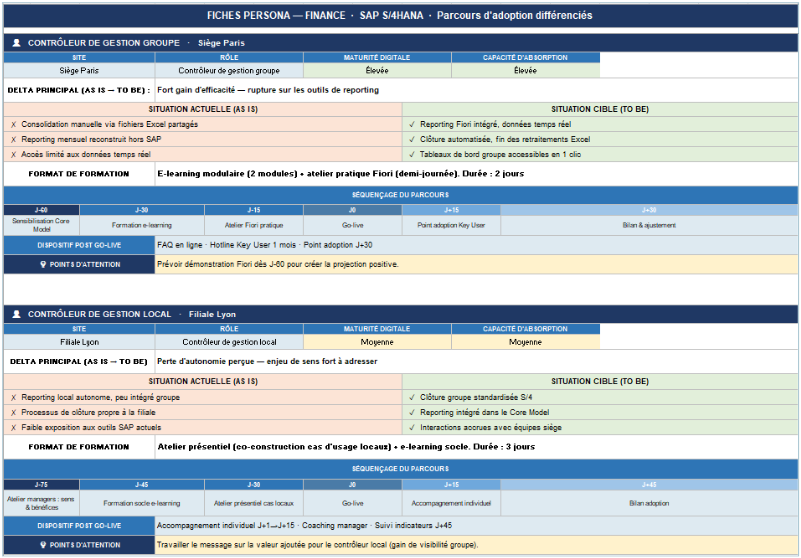
Differentiating adoption paths is the step that transforms a change strategy into an experience lived by each user. It builds on the personas developed upstream and enriches them with a local dimension.
- The construction of differentiated paths follows a three-step logic. First, define for each persona the delta between the current situation and the target situation: which transactions disappear, which appear, which processes change profoundly, which roles evolve. Then, evaluate the absorption capacity of each population: level of digital maturity, workload, history with previous transformations. Finally, build the adapted support path: sequencing of training, preferred formats, intensity of support, post-go-live support mechanisms.
- Training formats must be calibrated to local realities. Practical in-person workshops for populations unfamiliar with digital tools or whose processes are highly procedural. Modular e-learning for autonomous populations comfortable with self-training. Guided simulations on the target environment for critical processes or those with a high risk of error. Small group Q&A sessions for resistant populations, where discussion flows more freely than in plenary training.
- The involvement of local relays as co-designers of training content is a central methodological lever. When a Key User contributes to building the training scenario for their scope, they integrate real use cases, common errors, and operational shortcuts. The training gains relevance, and the Key User gains legitimacy with their peers.
Monitoring Local Adoption with Data and Continuous Adjustment
Local adaptation also requires fine and continuous monitoring of adoption, site by site, business function by business function, population by population.
Quantitative indicators help detect areas of fragility: usage rates of key transactions compared to expected volumes, number and nature of support tickets per site, training participation and completion rates, processing times for key processes post-go-live.
Qualitative indicators help understand what the numbers don’t show: structured feedback from Key Users during field feedback rituals, direct observations at workstations, analysis of system circumventions.
The articulation of these two types of data produces a continuously updated adoption heatmap by site and by population, which will allow for prioritizing corrective actions (detailed in article 2). This agility in monitoring is precisely what distinguishes living change management from a rigid plan. The Core Model does not change, but the way it is supported is constantly adjusted according to field signals.
In summary: Local Change, a Condition for the Success of the Global Core Model
A harmonized S/4HANA Core Model only achieves its full effectiveness if the accompanying change is perceived as locally relevant. This adaptation is a true strategic deployment that respects the specificities of each population while maintaining global coherence.
Expertise in change management consists precisely in orchestrating this complexity: sharing a clear line between invariant and adaptable, finely mapping local realities, structuring two-tier governance, involving field relays as co-designers, and continuously adjusting based on adoption feedback.
Ultimately, the Core Model becomes a living framework, carried by local teams who have appropriated it because they were given the means to do so.