



Today, 53% of payroll teams are facing staff shortages. As a result, they are dealing with a heavy workload despite reduced staffing levels.
This situation leads not only to payroll errors but also to penalties for non-compliance with current regulations. The health crisis contributed to this situation, affecting employee engagement, working conditions, and recruitment.
Even worse, 37% of payroll departments have seen more than 10% of their staff leave, aggravating the situation, not to mention the impact of absenteeism on HR services. The current crisis limits recruitment budgets for HR teams, making it harder to attract candidates. Yet, the strain on teams—often ignored by business leaders and HRDs—is very real.
Parlons RH, 2024 Barometer, Key figures to remember
Payroll managers are facing an intense workload. They often work overtime on payroll processing and social declarations (DSN). Additionally, they manage employee onboarding and offboarding in a complex social climate. Furthermore, in an evolving context for case law on paid leave during sick leave, this involves recalculating provisions.
Faced with these challenges, companies must rethink human resources management, particularly in terms of solutions, not necessarily through recruitment.
In response to this situation, Althéa, through its HR Performance department, offers concrete solutions (recovery of IJSS, optimization of social security contributions, and even outsourcing) to optimize HR functions. This support benefits cash flow while maintaining sound payroll and human resources management.
Economic levers to improve company operations and cash flow
Beyond operational management, human resources is a strategic hub and a driver of economic opportunities. Contrary to popular belief, these options—particularly outsourcing—do not represent an additional cost but are self-funding through the savings they generate, while improving overall efficiency.
Recovery of IJSS and optimization of social security contributions
An often underestimated first lever is the recovery of Daily Social Security Allowances (IJSS). These allowances, which compensate for employee absences due to sick leave, constitute a significant portion of costs for companies, especially when they opt for subrogation. However, it is possible to recover amounts owed by Social Security over the last 27 months, representing a significant opportunity to improve cash flow. While not always a priority, IJSS generate significant financial flows and can quickly lead to overlooked cash flow issues.
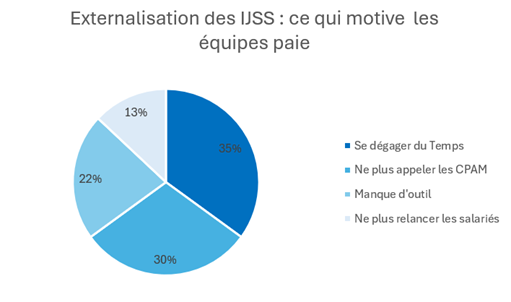
Prepayment of benefits also creates tension on cash flow. This requires special attention, particularly regarding long-term absences and higher salaries.
By outsourcing IJSS management, companies ensure efficient recovery and avoid administrative errors. A specialized provider, paid on a success-fee basis, ensures that every euro recovered more than covers the outsourcing costs. The operation is thus profitable and carries no financial risk.
Lacking the right tools and with teams under pressure, HR departments often prefer to handle IJSS themselves. Indeed, company culture often blocks the use of external specialists. However, thanks to their experience and high-performance tools, recovery is generally faster and more secure.
Optimization of social security contributions: a source of savings.
In parallel, optimizing social security contributions offers another way to achieve significant savings. The increasing complexity of social regulations leads many companies to overpay contributions. An external audit can identify and correct these errors, thereby freeing up significant financial resources.
New social measures are added to those already in force. Detecting them and understanding their impact is no easy task. Nor is measuring the financial stakes for one’s sector or company.
URSSAF audits aim to carry out adjustments identified remotely through DSN. Conversely, the search for potential savings is carried out with the support of an external expert.
- with legislative compliance,
- on the basis of a return on investment
The savings generated far exceed the costs, making the operation entirely self-funding. There are numerous sources of optimization, sometimes known but not implemented.
A change in management or a complex economic situation provides a new perspective on existing systems. Furthermore, even though payroll software improves over time, local configurations are necessary. These settings are specific to each company. Only payroll teams handle these configurations.
These savings can then allow the company to fund projects (new HRIS or other payroll module, etc.). This helps payroll teams and limits workload.
Outsourcing administrative tasks: a solution with no additional cost
Outsourcing administrative tasks, such as managing payroll, absences, IJSS, or medical check-ups, is self-funding.
Indeed, outsourcing reduces the administrative burden on internal teams while generating savings. Teams can focus on higher value-added missions. Specialized providers take over time-consuming or sensitive tasks.
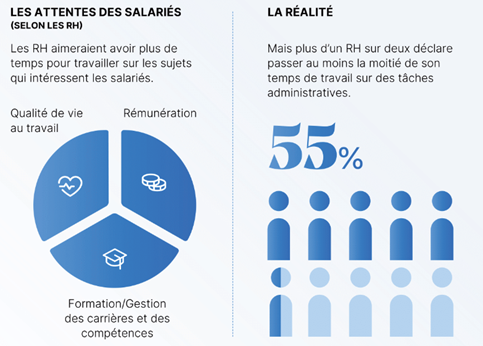
Parlons RH, 2024 Barometer, Key figures to remember
When understaffed, this approach compensates for the lack of internal human resources without having to recruit immediately. Additionally, success fees (performance-based pay) ensure that outsourcing does not result in any additional cost for the company.
Outsourcing, a winning solution
The idea that outsourcing represents an additional cost is a myth. In reality, when well-planned and managed, it is a lever for economic performance.
The savings achieved must exceed the costs incurred. Companies can improve their cash flow. They can also reduce their teams’ workload. This allows them to benefit from higher quality services.
Conclusion: Self-funding HR solutions
Managing payroll production and HR administration while understaffed requires rethinking current strategies. Outsourcing is not just an expense. It is a real opportunity for companies to save money. It improves their cash flow and helps internal teams.
Whether for IJSS recovery, social security contribution optimization, or task outsourcing, these actions are profitable. They are also necessary in a context of understaffing and budget cuts.
By adopting these solutions, companies can optimize their operations while maintaining a high level of compliance and efficiency. Althéa, through its department
HR Performance offers tailored support to guarantee concrete, measurable results that are immediately beneficial to the company’s cash flow.