


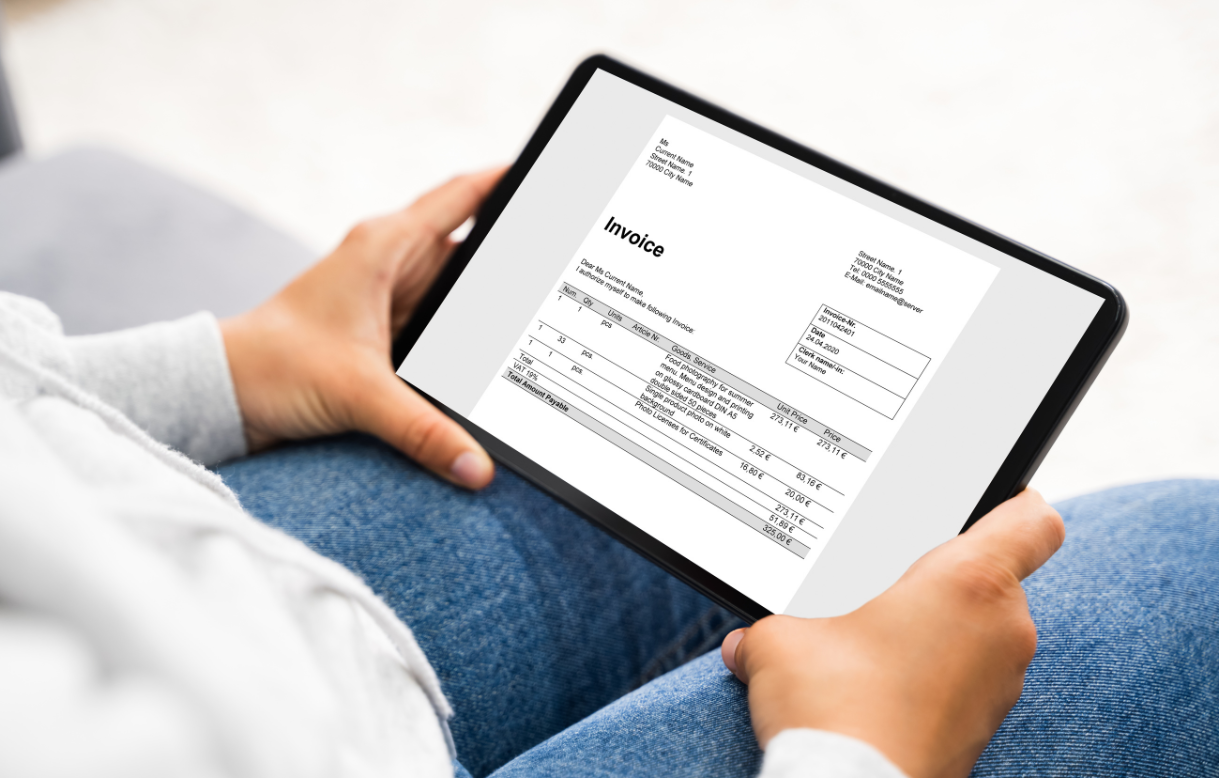
Today, regulations are being strengthened in France and Europe to encourage invoice digitization. Since January 1, 2020, French companies have been required to send their invoices in electronic format in the public sector and to perform e-reporting. According to Article 26 of the Amended Finance Act for 2022, this obligation extends to transactions between VAT-liable companies by September 1st, 2026 for large enterprises and mid-sized companies (ETI), and by September 1st, 2027 for SMEs and micro-enterprises.
However, despite these legislative incentives, few companies have yet taken the step toward complete digitization. This delay represents a major challenge for the future, as companies will need to adapt quickly to comply with new requirements and leverage the operational and economic benefits offered by digitization.
What is invoice digitization?
Supplier and customer invoice digitization involves replacing paper invoices with electronic documents, thereby optimizing the invoicing process.
This change is part of a broader trend toward document digitization, which aims to improve efficiency and reduce costs associated with managing physical documents.
Digitization enables companies to send and receive invoices in electronic format, facilitating tracking, archiving, and reviewing transactions.
What are the benefits of invoice digitization?
Implementing digitized invoice processes for suppliers and customers can deliver significant benefits to companies, both financially and operationally:
- Reduction in invoice management costs of up to 90% through process automation,
- Time savings on supplier invoice entry by accountants of 30%,
- Reduction in payment delays of 12%.
What are the challenges for companies?
As indicated above, French and European legislation has introduced numerous measures for the coming years regarding invoice digitization.
As we know, few companies have yet taken the step toward comprehensive digitization. Indeed, according to an IPSOS survey, 75% of surveyed companies stated they do not have a precise understanding of the implications of the electronic invoicing reform.
This is why this delay represents a major challenge for the future, as companies will need to adapt quickly to comply with new requirements and leverage the operational and economic benefits offered by digitization.
Here are examples of major challenges for companies:
Cost reduction
Reducing costs, particularly those related to managing and processing paper supplier invoices, such as printing, postal, and storage expenses.
Efficiency improvement
Improving process efficiency by accelerating invoice and payment processing times, reducing delays and human errors, and enhancing staff productivity through new, more powerful solutions offering greater functionality.
Reduction of manual tasks
Reducing low-value manual tasks by introducing automated processes for receiving, entering, matching, and validating supplier invoices, as well as automating customer invoice distribution processes.
Improved traceability
Improving traceability and transparency by enabling easier tracking of invoices throughout their lifecycle and ensuring better compliance with internal policies and external regulations.
Risk reduction
Reducing fraud and error risks by implementing more rigorous security controls, such as electronic signature validation and restricting access to sensitive data.
Compliance
Compliance with the Electronic Invoicing Reform (September 2026) and European and international reforms
Acting for sustainable development
Contributing to carbon footprint reduction by eliminating the need for paper and reducing travel related to handling physical documents.
Althéa, a firm that can help you with your invoice digitization processes

Althéa is a Management consulting firm with over 250 consultants possessing triple expertise: Consulting Methodology, IT Solutions & Business Functions.
In 2023, we generated 28 million euros in revenue.
We support our clients in their transformation projects across HR, Finance, Procurement, and Supply Chain, from building the transformation roadmap to operational project deployment.
Given the challenges of supplier and customer invoice digitization, Althéa can support you.
Examples of projects we deliver in France and internationally
To help our clients comply with the electronic invoicing reform and improve invoice processing workflows, here are examples of projects we deliver in France and internationally:
01 Master Plan:
- Defining the vision, objectives, and priorities around invoice processing workflows (customer & supplier) and RFE compliance.
- Establishing roadmaps for invoice processing challenges (customer & supplier) and RFE compliance.
- Audit and evaluation of current processes:
- In-depth audit of invoice processing workflows (customer & supplier),
- Identification of inefficiencies, gaps, and friction points (business and user) that may hinder productivity and compliance,
- Gap analysis with RFE, identification of use cases and data structure analysis, design of compliance initiatives.
- Solution benchmarking:
- Identifying a shortlist of solutions addressing our clients’ challenges and processes to engage them during the consultation phase.
- Selection support:
- Support in solution selection: drafting specifications and response grids, managing the tender process, and providing recommendations.
- Project Management Assistance (AMOA):
- Project management,
- Assistance during target process design and help collecting necessary configuration data,
- Facilitation of the solution testing phase,
- Support for technical interface and/or data migration initiatives.
- Change management and operational maintenance:
- Development of user and administrator documentation,
- Training on platform usage: end users, key users,
- Training on platform administration,
Our strategic approach centers on the essential objective of transforming organizations into more efficient, agile entities closely aligned with market best practices.
Examples of projects delivered by our experts
For the finance department of a French investment bank, deployment of a supplier invoice digitization solution (P2P)
Deliverables:
- Detailed audit of all processes,
- Interviews with key stakeholders (administrators, Management, end users, assistants),
- Identification of main pain points and improvement areas,
- Application mapping,
- Drafting of recommendations document and roadmap,
- Benchmarking of solutions considered for the consultation,
- Drafting of specifications for the consultation,
- Change management with business teams,
For the finance department of a major French home appliance company, selection and deployment of an e-invoicing tool compliant in France and internationally.
Deliverables:
- Regulatory monitoring in the group’s countries of operation,
- Benchmarking of the best customer invoice digitization solutions,
- Drafting of specifications distributed to selected vendors.
- Gap analysis of existing systems against electronic invoicing reform requirements,
- Support in selecting the O2C solution to deploy,
- AMOA implementation of the solution in France and internationally.
Althéa to support you
Supplier and customer invoice digitization represents a crucial challenge for companies seeking to improve their operational efficiency and comply with new legislative requirements.
At Althéa, we specialize in supporting companies at every stage of this transformation process. Indeed, our experts can help you navigate this change by optimizing your invoicing systems and ensuring your compliance with the electronic invoicing reform.
You can review our invoice digitization offering to learn more about how we can assist you.
Or contact our experts: