


In companies, payroll is often still perceived as an administrative function. Yet, it is one of the most critical systems within a company: it often represents by far the largest expenditure, involves a high level of regulatory complexity, and directly impacts employee trust.
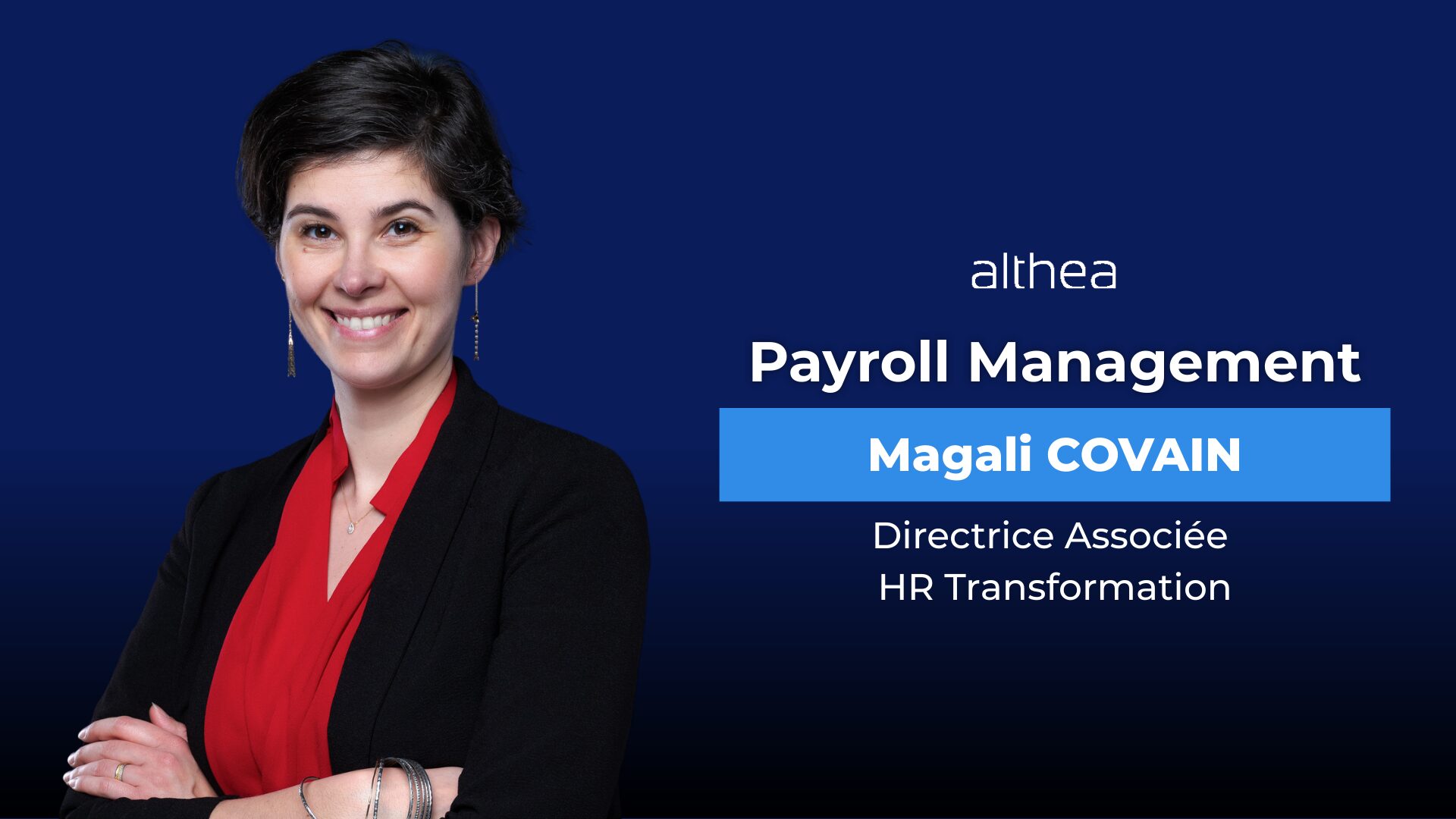
Magali Covain, Associate Director of HR Transformation and leader of Althéa’s Payroll Management offering, explains why payroll today goes beyond simply producing payslips to become a strategic lever for workforce cost management and HR transformation.
Why is payroll now a strategic topic for HR Departments?
Payroll and what it encompasses (salaries, charges, variables, benefits, C&B, etc.) often represent nearly 50% of a company’s expenses. It is therefore a major and essential lever for economic management.
However, beyond this financial dimension, payroll plays a central role in the organization’s operations. It requires maximum reliability of social information, conditions the relationship of trust with employees, and sometimes determines the credibility level of the HR function.
In practice, payroll far exceeds the role of a data entry operator. For HR Management, it involves mastering all processes and flows related to compensation: data reliability, control efficiency, operational security, and management of associated schemes. Beyond compliance, these issues directly impact cost control, but also the company’s ability to remain competitive and attractive in its compensation policy.
Payroll thus becomes a topic of cost control, employer attractiveness, and strategic human capital management.
Why does the payroll function remain difficult to stabilize?
Payroll is by nature a constantly evolving system.
It is subject to constant regulatory, conventional, and technical transformations. France is, moreover, one of the most complex environments in terms of payroll management.
It should be noted that the transformation also concerns the profession itself: payroll professions have profoundly evolved in recent years.
Formerly performed mainly by accountants, there was no dedicated payroll degree, and training was done “on the job,” whereas it is now part of complex digital ecosystems, integrating HRIS tools, automated flows, and largely dematerialized social declarations.
Today, payroll teams must combine regulatory expertise, mastery of tools, and understanding of data flows.
Added to this is a strong tension on skills: experienced profiles are particularly sought after, making their recruitment and retention more difficult, even as the lifespan of tools and versioning require more than ever to capitalize as much as possible on existing teams.
Payroll is therefore at the intersection of several challenges: regulatory, technological, organizational, and human.
How is the payroll function evolving?
We are witnessing a gradual transformation of the model.
Payroll has long been organized around individual expertise, with often very local practices. Companies are now seeking to structure this function more.
This evolution notably involves integrating payroll into HRIS ecosystems, which centralize social data and streamline information flows.
It also translates into a broader reflection on the organization of the function, with the development of shared service centers allowing certain activities to be centralized and practices harmonized.
The objective is not to reduce expertise, but on the contrary to enhance it by concentrating skills on higher value-added activities.
Payroll thus becomes a structuring function for HR management.
How do you assist HR Departments with these issues?
Our approach is first based on a thorough understanding of organizations.
Payroll is an area where standardized solutions rarely work. Each company has its own rules, its own tools, its specific expectations, and its own constraints.
We therefore often intervene through process diagnostics, compliance audits, or efficiency analyses, to identify weaknesses and levers for improvement.
Based on these analyses, we support companies in defining their Target Operating Model, transforming their payroll organization, evolving their tools, and securing their processes.
The objective is always the same: for all levels, from the sponsor to the operational staff, including the user: to strengthen the quality, reliability, and efficiency of the payroll function.
How does the Payroll Management offering fit into HR Transformation?
Payroll is often considered the last step in the HR chain.
Indeed, all the payroll experts in the world will not be enough if we do not first acknowledge that payroll depends on all the preceding processes: recruitment, Core HR, time management, planning, and skills management.
When upstream data is not properly structured, errors appear in payroll. This reality is often summarized by a simple English phrase “GIGO” (“garbage in, garbage out”), which can be translated into French as “foutaises à l’entrée, foutaises à la sortie” (garbage in, garbage out).
Today, it is clear that payroll is not limited to a data reception role. It also constitutes a point of production of strategic information, particularly for workforce cost management, budget simulations, or recruitment projections.
In the era of Data, payroll is thus at the heart of the circulation of social data within the company.
What does a secure and structured payroll function bring to the company?
A well-managed payroll function produces several structuring effects.
First, it secures financial flows and regulatory obligations, reducing the risks of errors or adjustments.
It also improves visibility for HR and Finance functions, which can rely on reliable data to manage workforce costs and anticipate the organization’s future needs.
By making processes reliable and structured, it also frees up time for higher value-added actions, such as reflection on compensation transparency or the evolution of compensation policies.
Finally, it strengthens employee trust in the organization. The quality of payroll directly conditions the relationship between the company and its employees and contributes, more broadly, to the overall credibility of the HR function.
How do you see the payroll function evolving in the coming years?
Several trends are emerging.
The first concerns the digitization and international harmonization of payroll systems. Companies are seeking to simplify their architectures and secure their data flows.
The second relates to organizational models. Some companies internalize their skills, while others explore different forms of outsourcing or managed services.
Finally, the challenges of data security, cybersecurity, and regulatory compliance are becoming increasingly important, particularly with the rise of SaaS environments and the advent of artificial intelligence.
The value of the payroll function will increasingly rely on the digitization and reliability of flows, whether inbound (HR data, time, variables) or outbound (social declarations, reporting). It will also require enhanced functional and technical expertise to master increasingly integrated environments, in which artificial intelligence is progressively being integrated into vendor solutions, particularly to automate controls, generate alerts, or facilitate comparative analyses.
Payroll can no longer be considered a simple administrative process.
It is now a strategic infrastructure for HR and financial management, at the heart of organizational transformation.
Mastering payroll means securing flows, ensuring the reliability of social data, and sustainably managing workforce costs. To learn more, discover Althéa’s Payroll Management offering, dedicated to securing and transforming payroll functions to serve organizational performance.