


Often reduced to an organizational exercise, planning has now become a strategic management lever.
In an environment marked by pressure on margins, the transformation of working methods, and the rise of data, companies must rethink how they align their resources with their actual needs.
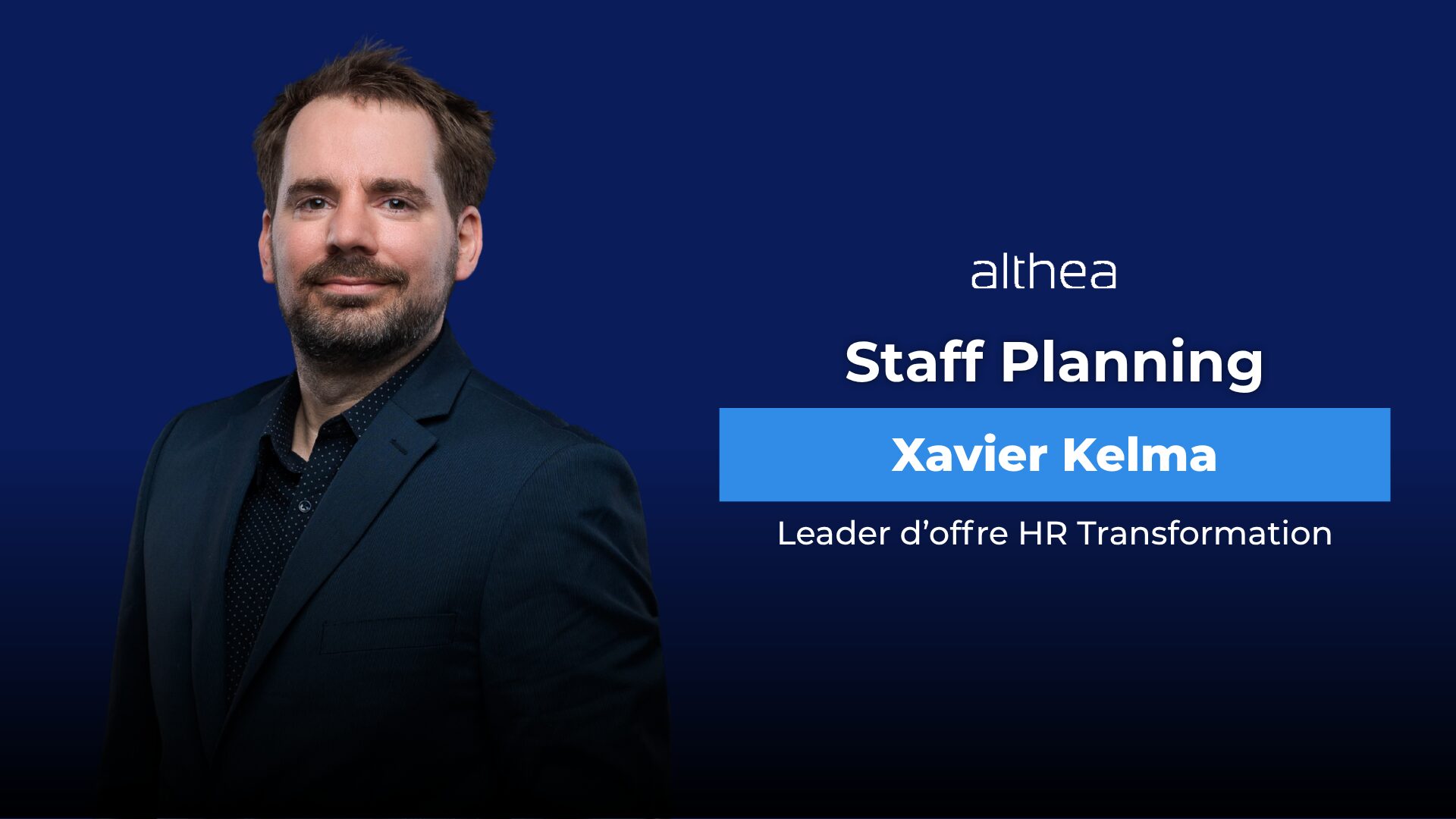
Xavier Kelma, Leader of the Staff Planning offering within Althéa’s HR Transformation practice, shares his perspective on the challenges and his experience.
Staff Planning is still often misunderstood. What are we talking about specifically?
There is indeed frequent confusion between planning and schedules.
A schedule is a deliverable. Staff Planning is a process.
It encompasses all the mechanisms that enable continuous alignment of the company’s resources with its operational needs. This requires solving an equation that appears simple: mobilize the right employee, at the right time, in the right place, with the right skills.
But behind this apparent simplicity lies a much more complex reality. The schedule is actually the culmination of a large number of parameters: business needs, available skills, organizational constraints, social rules, etc.
Reducing planning to a tool or a schedule therefore means ignoring the essential.
Despite the tools and data, why do we still observe so many difficulties?
This is precisely one of the current paradoxes.
Companies have more and more data and sophisticated tools, but this does not automatically translate into better planning.
We sometimes even observe the opposite effect. The availability of data can lead to a form of over-mathematization of the subject, with excessive confidence placed in models.
However, planning remains above all an operational matter. It requires a thorough understanding of the field, business constraints, and human behaviors.
Models do not replace analysis or experience.
When used in isolation, they can even produce counterproductive results, or results unsuited to reality.
Are planning tools overrated?
Tools are not the problem. But they are not the sole solution either.
A planning tool is based on simple logic: it translates the rules and methods provided to it. If these are unsuitable, the tool will only reproduce existing dysfunctions.
This is well summarized by the principle of “garbage in, garbage out.”
Furthermore, the sophistication of tools can create an illusion of control. The results produced, because they are structured and quantified, are perceived as reliable, even when they do not correspond to operational reality.
The real challenge therefore lies not in the choice of tool, but in the structuring of the planning model.
What are the warning signs that should alert organizations?
Dysfunctions related to planning are rarely identified as such. They manifest through symptoms, often analyzed in isolation.
On the finance side, they translate into difficulty managing payroll costs and discrepancies between budgets and actual expenses.
On the HR side, they appear in the form of turnover, absenteeism, or recruitment tensions.
Operationally, they manifest as difficulty covering needs, schedule instability, or day-to-day management focused on the unexpected.
Taken separately, these signals seem to relate to distinct issues.
Taken together, they generally reflect a structural weakness in planning.
How do you structure an effective planning approach?
The first step is to change perspective.
Planning cannot be addressed solely from a tools perspective. It must be approached as a cross-functional matter, at the intersection of HR, Finance, and Operations challenges.
The approach implemented at Althéa is based on this comprehensive logic.
It begins with a diagnosis of existing practices, to identify pain points and measure their impacts. It continues with work to structure processes, aiming to align planning methods with the actual needs of the business.
The human dimension is also central. Planning requires skill development for stakeholders, whether planners, managers, or support functions.
Tools come into play in a second phase, as a lever for industrialization and reliability, provided they are integrated into a coherent approach adapted to the specificities of each organization.
How is planning also a managerial matter?
Planning is often approached from a technical angle. It is in reality profoundly managerial.
It directly conditions work organization, the relationship between the manager and their teams, and the ability to effectively mobilize skills.
A skill has value only if it is used at the right time, under the right conditions. Planning is precisely what enables these conditions to be created.
It also impacts fundamental dimensions for employees: the clarity of their organization, the predictability of their activity, their personal balance.
As such, it constitutes a direct lever for engagement… but also a key factor in departure decisions.
What results can be expected from controlled planning?
When structured, planning produces rapid and measurable effects.
It reduces turnover and involuntary absenteeism, improves operational efficiency, and optimizes the use of existing resources.
It also strengthens the company’s ability to absorb activity variations and adapt to its environment.
Beyond organizational gains, it directly contributes to economic and social performance.
How will planning evolve in the coming years?
Planning is currently at a tipping point.
On one hand, data-driven approaches will continue to develop, driven by AI and simulation capabilities.
On the other, companies are becoming aware of the need to re-anchor planning in operational realities.
Performance will not come from choosing between these two approaches, but from their articulation.
The most mature organizations will be those capable of combining analytical power and thorough understanding of the field, to build planning that is robust, pragmatic, and scalable.
To Learn More
Would you like to assess your organization’s maturity in planning or structure your approach?
Althéa teams support HR, Finance, and Operations Departments in defining and implementing Staff Planning systems adapted to their challenges.