



An opinion piece by David Bellaïche, Chief Executive Officer of Althéa.
Generative AI is no longer a topic reserved for tech conferences. It is already here, in the hands of your employees, embedded in the new versions of your software, whether we decided it or not. What I have observed in the field for eighteen years is that major technological disruptions do not give warning. They arrive, and they divide organizations into two camps: those who anticipated, and those who catch up.
Honestly? I think we are still massively in the second camp.
“We have time”—the phrase I hear too often

Every week, in our assignments, we are told: “let’s wait for the solutions to stabilize,” “our priorities are elsewhere,” “we’ll see in 2026.” I understand the logic. There is something reassuring about waiting. Except that planning your organization three years out is not forecasting—it is short-term.
A transformation project for a function as central as Finance or Procurement cannot be launched in a few weeks. I have seen too many companies still suffering today from the consequences of poorly anticipated ERP projects. Months of diagnosis, months to build the target model, months to choose the right partners—and above all, months to truly support the teams. Not in communication, in real support.
And there is additional pressure that no one can ignore: the SAP ECC 2027 deadline. Thousands of companies will be forced to overhaul their Finance IT systems in emergency mode. I have already seen this film. When a project is driven by the calendar rather than by vision, we fix the technical aspects and botch the essentials—processes, organizations, internal control. Financial closings become disrupted. The reading of financial flows becomes blurred. AI will add an additional layer of complexity to these already strained organizations. This is not a catastrophic scenario, it is a probability.
Finance and Procurement: Functions Under Pressure That Cannot Afford Mistakes
These two departments have different cultures, distinct challenges, but they share one thing in common: they are overwhelmed. And AI radically changes what “being overwhelmed” can mean.
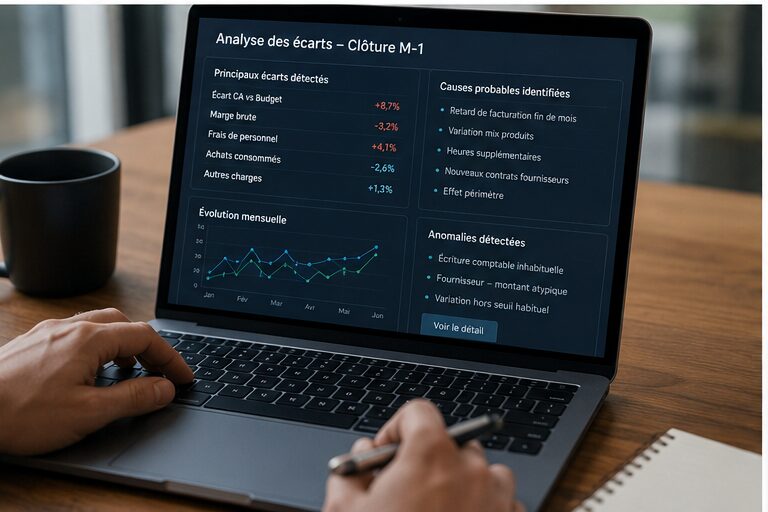
On the Finance Department side, I remember precisely what we observed at a major retailer. Management controllers spent an absurd proportion of their post-closing time commenting on variances. Meticulous work, often performed at night or on weekends, and which arrived too late to change anything. The data was there. But all the human energy was consumed producing it, not exploiting it. This is not a problem of intelligence or motivation—it is a structural problem.
With AI, we can imagine a controller who receives a first analysis already constructed: variances identified, probable causes, anomalies flagged. They can finally spend their time dialoguing with operations, challenging action plans. Becoming that business partner we have been calling for for twenty years without ever truly giving them the means.
On the Procurement Department side, the paradox is brutal. Their role has never been more strategic—securing supply chains, managing supplier performance, carrying CSR commitments. But in the field? Buyers spend an enormous amount of time being data archaeologists. I supported an industrial company whose buyers prepared their supplier reviews by consolidating order histories scattered across five different systems, quality incidents in spreadsheets, contractual data in emails. Each review was a marathon. AI can make this consolidation automatic. This is not trivial—it changes the buyer’s posture. They think strategy, not information logistics.
Do Not Start with the Choice of Tool
The first reflex I observe—and it is cultural, very French—is to ask which solution to choose. “Should we buy off-the-shelf or develop in-house?” This is the wrong question, or at least it is not the first one.
AI is not an application you plug in. It is a transformation that will deeply question your operating model. Before choosing the tool, you need to know what you want to build:
- Which roles will disappear? Which ones will emerge—data analysts, “augmented” controllers, strategic buyers?
- Which processes to standardize at scale, and which to keep flexible?
- Who is responsible for the quality of the data that feeds the AI? (Because an AI trained on bad data is worse than no AI.)
- Which skills to develop—and over what timeframe?
I will say it bluntly: AI is first and foremost a master plan project. IT comes after.
Three Horizons, but Not Three Distinct Phases
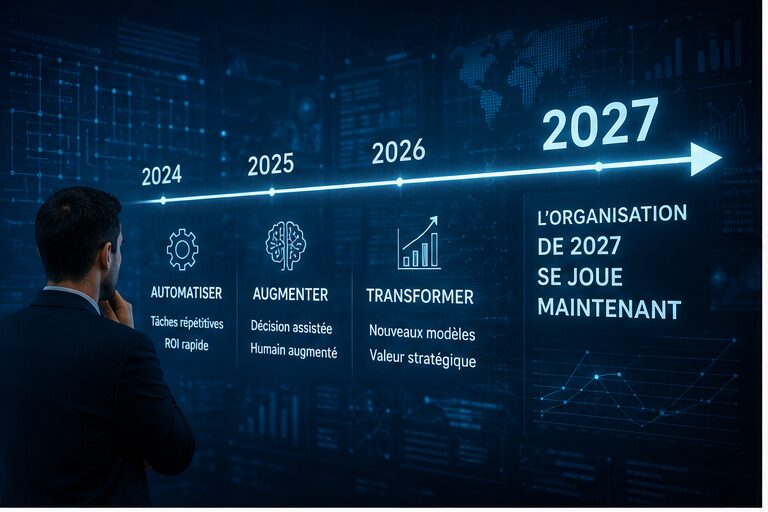
I am accustomed to thinking of this transformation in three overlapping rather than successive stages.
Automate first—repetitive tasks, recurring reports, invoice classification, contractual clause extraction. This is where the ROI is fastest. This is also where teams begin to experience AI firsthand without feeling threatened. Do not underestimate this aspect: the first experience matters enormously.
Augment next—the decision remains human, but it is equipped differently. I saw implemented in a large industrial group a system where AI synthesized responses to a tender, identified deviations from specifications, prepared a comparative analysis grid. In a few minutes. Buyers could focus on negotiation strategy, hidden risks, real value. This is not magic—it is redefining work.
Transform finally—and this is where it becomes dizzying. The management controller who models possible futures rather than commenting on the past. The buyer who manages a supplier ecosystem rather than negotiating prices. I saw a B2B services company where AI revealed pockets of profitability—and underperformance—completely invisible in the usual dashboards. The tool was not improving margins incrementally. It was changing strategic decisions.
Where to Start Concretely?
The worst approach would be to multiply “PoCs” in all directions to show that we are “doing AI.” It gives a clear conscience and builds nothing.
My conviction—after eighteen years of transformation and a few scars—is that we do not start from the technological. We start from the real pain points of the teams.
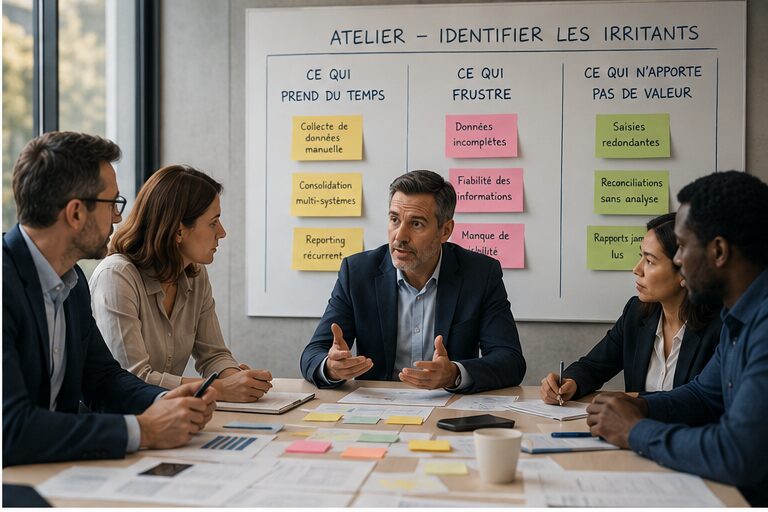
Organize workshops with your teams. Map where time is actually spent. Identify what frustrates, what is endured, what brings no value but is done anyway out of habit or lack of alternative. This is where real use cases are born—not from vendor catalogs.
Design your three-year target. What will be the mission of your Finance or Procurement function in 2027? What profiles will compose it? What organization will enable value extraction?
Build a realistic trajectory. A transformation is not an elevator, it is a staircase. You need quick wins to bring teams along—and show that it works. Without internal buy-in, the best target model remains a beautiful PDF document.
And truly put people at the center—not as a slogan, but in action. Resistance to AI is often legitimate fears, poorly heard. Change management work is not the cherry on top of a tech project. It is the sine qua non condition of its success.
The moment of truth is here. CFOs and Procurement Directors have a concrete choice to make—not philosophical, not futuristic—now: start building the 2027 organization, or wait for urgency to build it in their place.
I have rarely seen urgency build anything solid.
Written by